
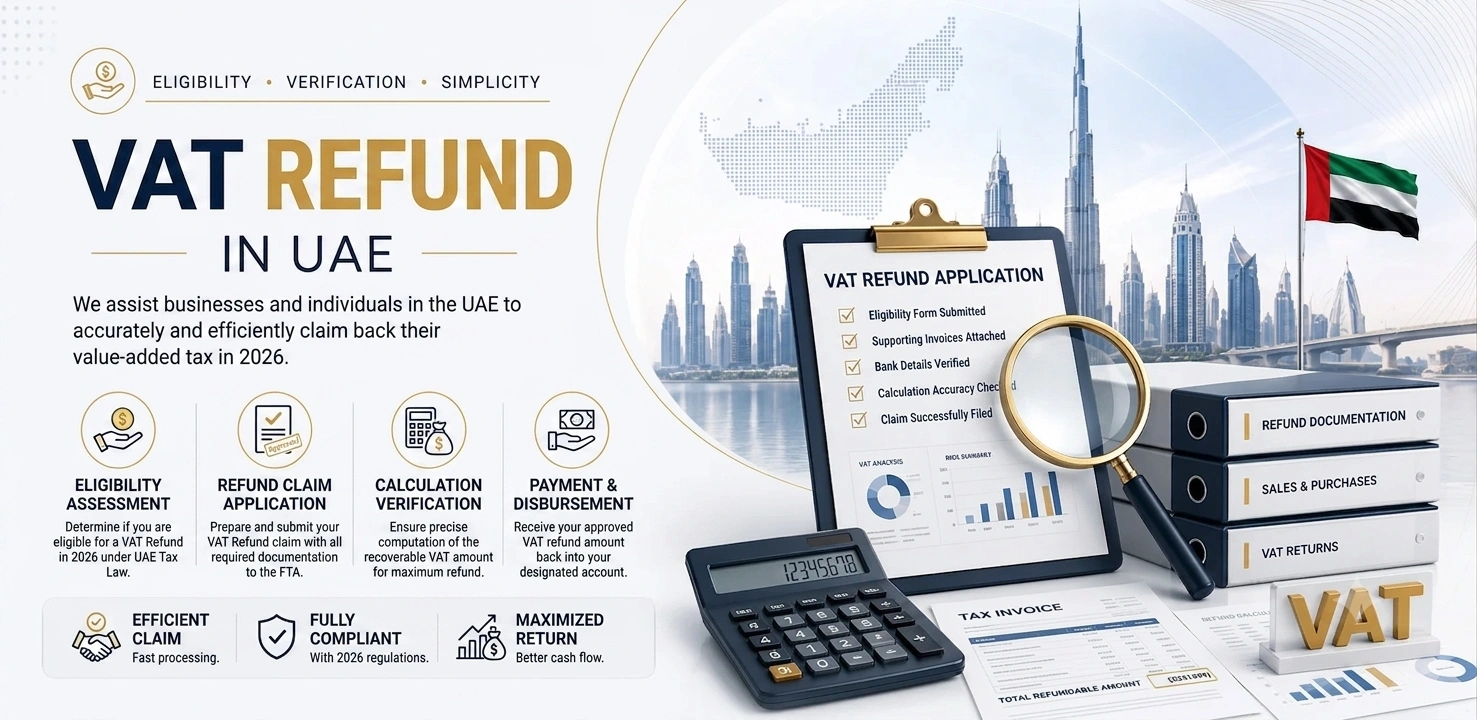
Over AED 115 million in UAE VAT refunds were processed in a single FTA cycle in late 2025. That is real money returned to real businesses but only the ones who knew how to claim it correctly, had the right documentation ready, and submitted within the required deadlines.
There is a significant amount of VAT that UAE businesses are entitled to recover but never claim — because they assume the process is complicated, or they carry credit balances forward indefinitely, or they simply do not know the mechanism exists for their situation. In 2026, all three of these reasons have become more expensive than ever.
From January 1, 2026, UAE VAT credits can no longer be carried forward indefinitely. The five-year expiry rule under Federal Decree-Law No. 17 of 2025 means credits from 2018 to 2021 will permanently disappear unless claimed before December 31, 2026. Foreign businesses that incurred UAE VAT during 2025 have until August 31, 2026 to apply a window that is already more than half closed. And UAE nationals building new homes just received an expanded refund entitlement worth an average of AED 25,000 per claim, announced by the FTA on June 9, 2026.
This guide covers all of it clearly, practically, and with the deadlines you actually need to act on right now.
Who Can Claim a VAT Refund in UAE?
There are four distinct categories of VAT refund UAE claimants and the rules, process, and deadlines are different for each:
| Claimant Type | Refund Mechanism | Key Deadline |
|---|---|---|
| UAE VAT-registered businesses | EmaraTax — Form VAT311 via quarterly/annual return | 5-year limit from period end |
| Foreign businesses (no UAE establishment) | Business Visitor Refund Scheme — EmaraTax | August 31, 2026 for 2025 VAT |
| UAE nationals building new homes | UAE Nationals Home Construction Refund | Ongoing — expanded from January 2026 |
| Tourists | Planet Tax Free scheme at UAE exit points | Within 90 days of purchase |
This guide focuses exclusively on the first three categories — business VAT refunds — not the tourist scheme, which is a completely different process managed by Planet Tax Free and not relevant to commercial operations.
Category 1: UAE VAT-Registered Businesses The Standard Refund Process
If your UAE VAT-registered business consistently pays more input VAT on purchases than it collects in output VAT on sales, you have a VAT credit balance and that balance can either be carried forward to offset future liabilities, or refunded directly to your bank account by the FTA.
The most common business types with refundable VAT positions:
- Exporters — zero-rated sales mean no output VAT collected, but input VAT is paid on UAE purchases and overheads. Export-heavy businesses frequently accumulate significant refundable credits
- Real estate developers — high upfront construction costs with significant input VAT, but sales may be exempt (residential) or zero-rated, limiting output VAT
- Startups in capital expenditure phases — significant input VAT on equipment, fit-outs, and professional fees before revenue begins flowing
- Seasonal and project-based businesses — hospitality, events, and construction companies with uneven quarterly VAT positions
How to claim a VAT refund through EmaraTax:
Step 1: Log in to your EmaraTax account at eservices.tax.gov.ae. Navigate to your VAT dashboard.
Step 2: Submit your VAT return for the relevant tax period accurately and completely. Your refund position is automatically calculated based on your declared input and output VAT figures. Errors in the return directly cause errors in the refund claim.
Step 3: Once your return is submitted and shows a net credit position, navigate to VAT Refund Form VAT311 within EmaraTax. This is the dedicated refund application form — separate from your return filing.
Step 4: Complete VAT311 accurately. Provide your bank account details (UAE IBAN), the refund amount claimed, and the tax period(s) covered. The FTA will cross-reference this against your submitted returns.
Step 5: Upload supporting documentation. The FTA typically requires selected invoices, export documentation (for zero-rated exporters), and bank statements confirming business transactions.
Step 6: Monitor your EmaraTax dashboard for FTA correspondence. The FTA’s standard processing timeline for VAT refund applications is 20 business days for straightforward claims — but complex or large claims can take longer, particularly if a verification visit or additional documentation is requested.
Step 7: Once approved, the FTA transfers the refund directly to your registered UAE bank account. If the FTA partially approves your claim, they will notify you of the approved amount and the reasons for any reduction.
The Five-Year VAT Credit Limit The Most Urgent Issue for UAE Businesses Right Now
Before January 1, 2026, UAE businesses could carry forward excess input VAT credit balances indefinitely — waiting years before deciding whether to claim a refund or offset against future liabilities. That era is permanently over.
Under Federal Decree-Law No. 17 of 2025, effective January 1, 2026, a strict five-year limitation period now applies to all VAT refund claims and credit balances. Any credit not claimed within five years from the end of the tax period in which it arose expires permanently.
The transitional relief — and the December 31, 2026 deadline:
Credits from 2018, 2019, 2020, and parts of 2021 technically already exceeded the five-year window when the new law took effect. Rather than immediately extinguishing these historic balances, the UAE Government provided a transitional grace period — giving these credits until December 31, 2026 to be claimed through VAT311 or offset against current liabilities.
After December 31, 2026 — no further claims, no extensions, no exceptions.
What to do right now:
- Log into EmaraTax and review your VAT credit balance history from 2018 onwards
- Identify every tax period where excess input VAT was carried forward without being refunded
- Calculate the five-year window from each period’s end date
- Submit VAT311 for any credits approaching or past their five-year limit
- For credits from 2018 to 2021 — submit before December 31, 2026
Our VAT services team at JASM Accounting regularly conducts VAT credit balance reviews that identify historic refund entitlements businesses did not know they had — and files the VAT311 applications before the expiry window closes.
Category 2: Foreign Business VAT Refund UAE August 31, 2026 Deadline
This is the most time-sensitive section of this entire guide and the one most applicable to international companies that visit or conduct business activities in the UAE without having a UAE establishment or VAT registration.
Under the UAE Business Visitor Refund Scheme, foreign businesses that incurred UAE VAT on eligible expenses during the 2025 calendar year can reclaim that VAT — but only if they apply through EmaraTax between March 1, 2026 and August 31, 2026. After August 31, the window for 2025 VAT closes permanently.
Who qualifies for the Business Visitor Refund Scheme:
- The business must have no place of establishment or fixed establishment in the UAE
- The business must not be a taxable person in the UAE
- The business must be registered with a competent authority in its home country
- The business must be established in a country that provides reciprocal VAT refunds to UAE businesses
- The minimum claim threshold is AED 2,000
Eligible expense categories for foreign business refunds:
- Accommodation (hotels, serviced apartments)
- Business event attendance, trade fairs, and exhibitions
- Business meeting expenses
- Transportation within the UAE
- Other eligible business expenditure per UAE VAT regulations
Documents required:
- Original Tax Compliance Certificate (business registration equivalent) attested by the UAE Embassy in the home country — original hard copy required
- Valid UAE tax invoices with supplier TRN for every expense claimed
- Proof of payment for each invoice
- Completed EmaraTax application
The August 31, 2026 urgency is real. If your company attended GITEX, Arab Health, Cityscape, or any other UAE trade event in 2025 and incurred hotel, transport, or event costs with UAE VAT charged that VAT is recoverable, but only until August 31. After that date, it is gone.
For assistance with compiling documentation and submitting the foreign business refund application before the deadline, our accounting outsourcing team handles end-to-end refund applications for international clients operating in the UAE.
Category 3: UAE Nationals VAT Refund New Home Construction AED 25,000 Expansion
On June 9, 2026, the Federal Tax Authority announced a significant expansion to the VAT refund scheme for UAE nationals constructing new residences — a development that was immediately relevant to thousands of Emirati families and largely missed by most accounting and tax advisory blogs.
Under the expanded scheme:
- UAE nationals constructing new residential properties on personal land can claim back VAT paid on eligible construction expenses
- The FTA expanded the scope of eligible expenses under this scheme from January 1, 2026
- The average VAT refund per qualifying claim is approximately AED 25,000
- Total approved refunds under this scheme are expected to exceed AED 1 billion in 2026 — up from AED 754 million in 2025
- The expansion applies to all claims submitted on or after January 1, 2026
This is relevant not just to individual UAE nationals but to UAE-based construction companies, contractors, and suppliers working on residential projects for Emirati clients — because correctly issuing compliant tax invoices is a prerequisite for your client’s refund claim, making your invoicing accuracy directly important to your client’s financial outcome.
For UAE nationals wanting to understand the full scope of eligible construction expenses under the expanded scheme, our team at JASM Accounting can review your project expenses and prepare a compliant refund application.
Why VAT Refund Claims Can Trigger an FTA Audit And How to Claim Safely
This is the section that no competitor article covers adequately — and it is the one that matters most to UAE businesses with significant refund claims.
The FTA is explicit: large or unusual VAT refund claims are one of the top triggers for VAT audit selection in 2026. The FTA’s data analytics systems flag refund claims that are significantly larger than the business’s historical patterns, inconsistent with the industry norm, or submitted close to the credit expiry deadline after years of carrying forward without claiming.
This does not mean you should not claim what you are entitled to. It means you should claim it correctly and be prepared for verification.
How to claim your VAT refund without unnecessarily attracting scrutiny:
Claim regularly — not in one large historic lump. Businesses that have been carrying forward credits for years and submit one large VAT311 for multiple periods simultaneously are more likely to face verification than those who claim quarterly or annually as credits arise.
Ensure your VAT returns are accurate before filing VAT311. The FTA cross-references your refund application against your submitted returns. Discrepancies between your VAT return data and your refund claim are an immediate red flag. Clean VAT record keeping and accurate return filing are the first defence against unnecessary audit attention.
Have your documentation organised before you submit. Invoice files, export documentation, and bank statements should be ready before you submit VAT311 — not scrambled together after the FTA requests them. Slow or incomplete responses to FTA verification requests during the refund review process escalate routine checks into formal audits.
Ensure your VAT and Corporate Tax filings are consistent. The FTA now cross-matches VAT returns against Corporate Tax filings — and discrepancies between declared revenue figures across the two systems are a leading audit trigger in 2026. If your VAT return shows AED 3 million in taxable supplies but your Corporate Tax return shows AED 4 million in revenue with no explanation — a refund claim submitted at the same time dramatically increases your audit exposure.
Our VAT compliance review service specifically addresses this — reviewing your VAT returns, Corporate Tax filings, and refund position together before any VAT311 is submitted, ensuring consistency and minimising unnecessary FTA attention.
Common Reasons VAT Refunds Are Rejected in UAE
Understanding why claims are rejected saves time and protects your refund entitlement:
| Rejection Reason | How to Avoid It |
|---|---|
| Non-compliant tax invoices | Verify all invoices meet FTA requirements — correct TRN, AED VAT amount, sequential number |
| Outstanding VAT return penalties | Clear all penalties before submitting VAT311 — outstanding fines can block refund processing |
| Inconsistent VAT return data | Reconcile returns before claiming — FTA cross-references every figure |
| Insufficient export documentation | For zero-rated exporters — maintain export declarations, shipping records, and proof of supply outside UAE |
| Blocked input VAT incorrectly claimed | Entertainment, personal expenses, and motor vehicles are blocked — ensure these are excluded |
| Claimed amount exceeds approved credit | Do not claim more than your net credit balance — this triggers immediate rejection |
| Late submission (foreign businesses) | Submit before August 31, 2026 for 2025 expenses — no exceptions after deadline |
| Missing reciprocal country status (foreign businesses) | Verify your home country is on the FTA’s approved reciprocal list before applying |
5 FAQs — VAT Refund UAE
How long does the FTA take to process a VAT refund in UAE? The FTA’s standard processing timeline for straightforward VAT311 refund applications is 20 business days from the date of receiving a complete, accurate application with all required supporting documentation. Complex claims, large refund amounts, or applications requiring additional verification can take longer. Submitting incomplete documentation or inconsistent return data is the most common cause of delays — the FTA will request additional information, resetting the timeline each time.
What is the deadline for foreign businesses to claim UAE VAT refunds for 2025? Foreign businesses that incurred UAE VAT on eligible business expenses during the 2025 calendar year must submit their refund application through the EmaraTax platform between March 1, 2026 and August 31, 2026. After August 31, 2026, the window for 2025 VAT claims closes permanently — no extensions are available. Foreign businesses must meet the minimum AED 2,000 claim threshold and provide an attested Tax Compliance Certificate from their home country along with original UAE tax invoices.
What is the five-year VAT credit limit in UAE 2026? From January 1, 2026, under Federal Decree-Law No. 17 of 2025, VAT credit balances can only be carried forward for five years from the end of the tax period in which they arose. After five years, unused credits expire permanently. Credits from 2018, 2019, 2020, and parts of 2021 that technically already exceeded the five-year window benefit from a transitional grace period until December 31, 2026 — after which any unclaimed balances from those periods are permanently lost.
Can claiming a VAT refund trigger an FTA audit in UAE? Large, unusual, or historically inconsistent VAT refund claims are listed by the FTA as one of the key audit selection triggers in 2026. Submitting a VAT311 does not automatically result in an audit — but claims that are significantly larger than historical patterns, submitted close to credit expiry deadlines after years of inactivity, or inconsistent with the business’s declared Corporate Tax revenue position face a higher probability of verification. Maintaining clean, consistent VAT records and ensuring VAT and Corporate Tax filings reconcile before submitting a refund claim significantly reduces unnecessary audit exposure.
What expenses qualify for the UAE Business Visitor VAT refund? Foreign businesses visiting the UAE can claim VAT refunds on eligible business expenses including hotel accommodation, business event and trade fair attendance fees, business meeting costs, and UAE transportation. The expenses must be supported by valid UAE tax invoices showing the supplier’s TRN, and the claim must meet the AED 2,000 minimum threshold. Personal expenses, entertainment, and goods consumed in the UAE do not qualify. The foreign business must also be established in a country with a reciprocal VAT refund arrangement with the UAE.
Your VAT Refund Is Not a Favour From the FTA — It Is Your Money
VAT refunds are not a discretionary benefit. They are a legal entitlement under UAE VAT law — money your business paid that it is entitled to recover. The only question is whether you claim it correctly and within the deadline, or lose it permanently.
The December 31, 2026 expiry of historic credits. The August 31, 2026 foreign business deadline. The newly expanded UAE nationals home construction scheme. All of these represent real dirhams that will either be returned to the businesses and individuals who are entitled to them — or retained by the FTA because the claim was never submitted.
At JASM Accounting, our VAT specialists manage complete VAT refund processes for UAE businesses across Dubai, Abu Dhabi, Sharjah, and all free zones — from identifying your full refund entitlement and preparing VAT311 applications, to ensuring your VAT returns and corporate tax filings are consistent before any claim is submitted.
📞 Book your free VAT refund review today — before your deadline arrives: jasmaccounting.ae/contact
