
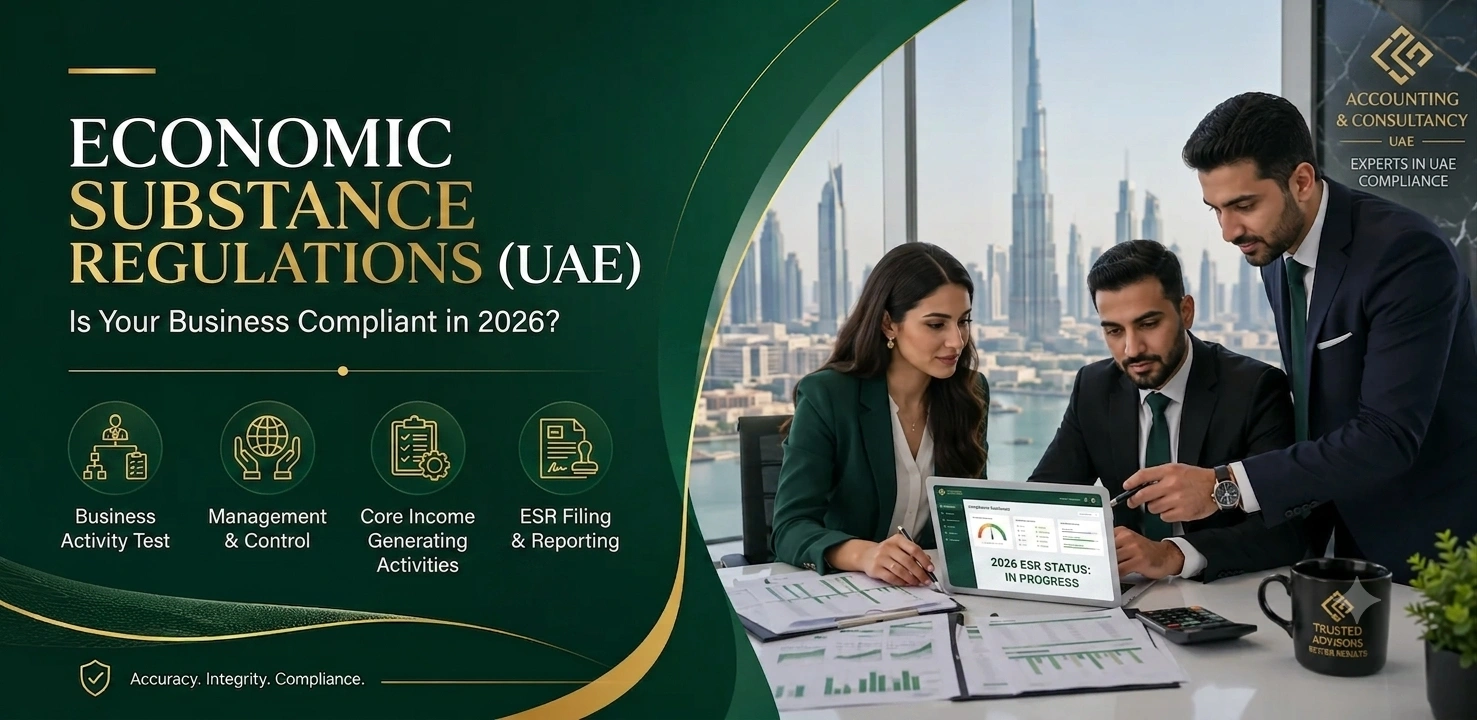
Here is the misconception that is quietly creating serious financial risk for hundreds of UAE businesses right now: Economic Substance Regulations are finished. The filings ended. The regime is over. We do not need to worry about substance anymore.
This is wrong — and it is one of the most expensive misunderstandings in the UAE business compliance landscape in 2026.
The standalone ESR filing requirement ended for financial years after December 31, 2022. That part is accurate. But what most UAE businesses do not realise is that the economic substance regulations UAE framework did not disappear — the concept was absorbed directly into the UAE Corporate Tax system. Today, if you operate from a UAE free zone and want to access the 0% corporate tax rate, your business must satisfy a substance test every single tax period. Not on a form filed with your free zone authority. Through your corporate tax return, enforced by the Federal Tax Authority.
A free zone company that fails the substance test in 2026 does not just lose a filing status. It loses its Qualifying Free Zone Person (QFZP) eligibility — and faces the standard 9% corporate tax rate on all income for that entire tax period, with no ability to reverse the position retroactively. For a company with AED 2,000,000 in qualifying income, that is AED 146,250 in unexpected corporate tax — from a substance failure that could have been identified and corrected before the tax year closed.
This guide explains where substance requirements stand in 2026, what the three-pillar test actually requires, and what the practical risks are for both mainland and free zone UAE businesses.
What Are Economic Substance Regulations in UAE?
The UAE introduced Economic Substance Regulations through Cabinet Resolution No. 31 of 2019 — as part of its commitments to the OECD Inclusive Framework and in direct response to assessment by the EU Code of Conduct Group on Business Taxation.
The core idea behind ESR is straightforward: a business claiming the benefits of operating in the UAE must actually operate in the UAE. It must have real people doing real work in a real office not just a registered address, a flexi-desk, and a post box collecting correspondence.
The regulations required UAE businesses conducting specific “Relevant Activities” to demonstrate that their actual economic activity was genuinely located in the UAE not artificially structured to benefit from a low-tax jurisdiction while the real decision-making and operations happened elsewhere.
From 2019 to 2022, this was tested through annual ESR notifications and reports filed with free zone authorities and the Ministry of Finance. For periods after December 31, 2022, Cabinet Decision No. 98 of 2024 formally ended the standalone ESR filing requirement.
But here is what that decision did not do: it did not end the relevance of economic substance to UAE businesses. It transferred the substance test from a standalone compliance framework into the Corporate Tax regime — where it now sits at the heart of the QFZP qualification.
ESR in 2026 Where Do Things Actually Stand?
For historical periods (2019 to 2022): ESR obligations still exist. If your business conducted Relevant Activities between January 1, 2019 and December 31, 2022, you were required to file ESR notifications and, if income was earned, ESR reports. The Ministry of Finance can still review and penalise non-compliance for these periods. Assuming that because ESR filings ended going forward, historic obligations have also been extinguished is incorrect — and a potentially costly assumption.
For 2023 onwards: Standalone ESR filings are no longer required. However, the substance concept is now embedded in two places:
1. The QFZP test for free zone companies To qualify as a Qualifying Free Zone Person and pay 0% corporate tax on qualifying income, a free zone company must maintain adequate economic substance in its free zone. The FTA assesses this through the corporate tax return and, where required, through audit. Failing the substance test means losing QFZP status — not just for the year of failure, but for the current period and potentially beyond if the underlying issues are not resolved.
2. The management and control principle for corporate tax residency A company that is legally registered outside the UAE but is effectively managed and controlled from the UAE can be treated as a UAE resident entity for corporate tax purposes — bringing its worldwide income within the UAE tax net. Conversely, a UAE company that is effectively managed from overseas could face questions about its actual tax residency. These determinations rest heavily on substance factors — where decisions are made, where directors meet, and where the genuine business operations occur.
The Nine Relevant Activities Does ESR Apply to Your Business Historically?
For businesses reviewing their 2019 to 2022 position, the nine Relevant Activities that triggered ESR obligations were:
| Relevant Activity | Typical Business Types |
|---|---|
| Banking | Licensed banks and financial institutions |
| Insurance | Insurance and reinsurance companies |
| Investment fund management | Fund managers and advisors |
| Lease finance | Companies providing finance leases |
| Headquarters | Regional headquarters managing group entities |
| Shipping | Companies operating ships for commercial cargo |
| Holding company | Pure holding entities owning shares in subsidiaries |
| Intellectual property | IP holding and licensing businesses |
| Distribution and service centre | Regional distribution hubs and shared services |
If your business conducted any of these activities between 2019 and 2022 and did not file the required ESR notifications and reports — you have an unaddressed historic liability that the Ministry of Finance can still identify and penalise.
The Three Pillars of Economic Substance — People, Premises, Expenditure
Whether we are discussing historic ESR compliance or the current QFZP substance test, the practical assessment comes down to three things. Not nine. Not twenty. Three.
Pillar 1: People The business must have qualified employees physically present in the UAE who are actively carrying out the activities that generate its income. These cannot be nominal roles, administrative placeholders, or staff whose only function is to maintain a local presence on paper. The employees must be genuinely involved in the business — attending management meetings, making operational decisions, and performing the core income-generating work that the business is actually paid for.
A DMCC commodities trader with one part-time administrator in Dubai and a management team that meets entirely in London does not have adequate substance from a people perspective — regardless of how many employees are on the trade licence.
Pillar 2: Premises The business must have a real, physical presence in the UAE that is appropriate to the scale and nature of its operations. This does not necessarily mean a large, expensive office. But it does mean a functional, dedicated space that the business genuinely uses for its activities.
This is where flexi-desks, hot-desk packages, and virtual office arrangements have become increasingly problematic. The FTA’s position in 2026 is clear: a flexi-desk arrangement that amounts to little more than an address and access to a shared meeting room on request does not constitute adequate premises for a business generating significant qualifying income. Virtual office setups are worse — they provide an address but no actual physical space at all.
For a free zone company relying on QFZP status for the 0% corporate tax rate, a flexi-desk arrangement is a substance risk that should be evaluated and addressed as a priority.
Pillar 3: Expenditure The business must incur operating expenditure within the UAE that is proportionate to its activities and revenue. A company generating AED 5,000,000 in annual revenue with AED 8,000 in annual UAE operating costs raises immediate questions about whether it is genuinely operating where it claims to be.
The expenditure test is proportional — not an absolute figure. A modest holding company with AED 500,000 in annual dividend income and AED 40,000 in UAE operating costs may satisfy the test. The same business with AED 10,000,000 in IP licensing revenue and AED 40,000 in costs almost certainly does not.
All three pillars must be satisfied simultaneously. Passing two but failing one is still a substance failure.
Economic Substance and QFZP The 2026 Critical Connection
This is the section most UAE free zone business owners have not yet connected — and it is the most financially significant part of the entire economic substance landscape in 2026.
To qualify as a Qualifying Free Zone Person and access the 0% corporate tax rate on qualifying income, a free zone company must:
- Conduct qualifying activities from its free zone
- Have adequate economic substance in the UAE relative to those activities
- Maintain audited financial statements
- Apply arm’s-length pricing to related-party transactions
- Keep non-qualifying UAE mainland income below 5% of total revenue or AED 5,000,000
The adequate economic substance requirement is the QFZP’s direct successor to the ESR substance test. It uses the same three-pillar framework — people, premises, expenditure — and it is tested every tax period, not just once.
A free zone company that satisfied ESR requirements in 2021 and has since moved to a smaller flexi-desk package, reduced its UAE headcount, or allowed its local expenditure to fall relative to growing revenues needs to reassess whether its substance position still supports QFZP qualification. The test is applied to current facts — not historical compliance.
Losing QFZP status has a compounding effect:
- 9% corporate tax applies to all income in the failed period — not just the income that caused the failure
- Re-qualifying requires demonstrating restored substance in a subsequent period
- The FTA can review QFZP status retrospectively during an audit
Our corporate tax advisory team conducts annual QFZP substance assessments for free zone clients — evaluating all three pillars against current facts before each corporate tax period closes, when corrective action is still possible.
Economic Substance UAE Penalties What Non-Compliance Costs
For historical ESR periods (2019 to 2022), the penalty framework under the regulations remains applicable:
| Violation | Penalty |
|---|---|
| Failure to file ESR notification | AED 20,000 |
| Failure to file ESR report | AED 50,000 |
| Failure to meet the Economic Substance Test | AED 50,000 (first year), AED 400,000 (subsequent years) |
| Providing inaccurate information | AED 50,000 |
| Failure to provide information to regulatory authority | AED 50,000 |
| Repeated failures | Licence suspension, revocation, or non-renewal |
For 2023 and beyond, the penalty for failing the substance test under the QFZP framework is not a direct fine — it is the loss of the 0% tax rate and exposure to 9% corporate tax on all income. For a company with AED 3,000,000 in qualifying income, this represents AED 236,250 in corporate tax that was not expected, planned for, or budgeted.
Practical Steps to Assess Your Economic Substance Position in 2026
Step 1: Review your 2019–2022 filing position If your business conducted any of the nine Relevant Activities between 2019 and 2022, confirm that all required ESR notifications and reports were filed. If filings were missed, assess the penalty exposure and consider whether a voluntary disclosure approach reduces the liability.
Step 2: Assess your current QFZP substance For free zone companies, evaluate all three pillars against current facts — are your UAE employees genuinely involved in core activities, is your office space real and adequate, and is your UAE expenditure proportionate to your revenue? If any pillar is borderline, address it before the tax year ends.
Step 3: Review your flexi-desk or virtual office arrangement If your free zone company operates from a flexi-desk or virtual office, assess honestly whether that arrangement supports QFZP substance — or whether upgrading to a dedicated office is the correct position given your revenue and activity levels.
Step 4: Document substance evidence Even where substance genuinely exists, poor documentation is one of the most common causes of adverse outcomes during FTA audits. Employment contracts, payroll records, office lease agreements, board meeting minutes held in the UAE, and UAE bank statements all contribute to a defensible substance position. Our financial reporting and VAT record keeping teams build this documentation as a standard part of annual compliance for our free zone clients.
Step 5: Integrate substance into your corporate tax planning Substance is not a standalone compliance exercise in 2026 — it is a corporate tax planning input. The decision between maintaining QFZP status (and its substance requirements) versus operating as a standard taxable entity (9% rate, no substance test) needs to be modelled against your actual revenue mix, headcount, and UAE operating cost position. Our accounting outsourcing service integrates this analysis into annual client reviews.
Economic Substance UAE Mainland Companies
Economic substance for mainland UAE companies operates differently from the free zone QFZP framework. Mainland companies registered with a DED licence are not subject to the QFZP substance test — they are taxed at 9% on income above AED 375,000 as the standard position.
However, mainland companies with international group structures — for example, a UAE holding company owned by a foreign parent — still need to consider substance in two contexts:
Management and control: If the effective management and control of the UAE entity is exercised from overseas — decisions made by foreign directors who never visit the UAE, board meetings held entirely abroad — the entity may not be treated as a UAE tax resident for corporate tax purposes. This can eliminate expected treaty benefits and tax planning structures.
Transfer pricing: UAE mainland companies transacting with overseas related parties must demonstrate that the pricing of those transactions is consistent with what unrelated parties would agree — the arm’s length principle. Substance in the UAE is a supporting factor in demonstrating that the UAE entity adds real value to the transactions it participates in.
For UAE groups with complex structures, our corporate tax advisory and financial reporting support includes annual review of management and control positions across entity layers.
5 FAQs Economic Substance Regulations UAE
Do Economic Substance Regulations still apply to UAE businesses in 2026?
Yes — but in a different form than before 2023. The standalone ESR filing requirement ended for financial years after December 31, 2022 under Cabinet Decision No. 98 of 2024. However, the concept of economic substance has been absorbed into the UAE Corporate Tax framework — specifically the Qualifying Free Zone Person test. Free zone companies must demonstrate adequate economic substance every tax period to maintain QFZP status and the 0% corporate tax rate. Failing the substance test means losing QFZP eligibility and facing 9% corporate tax on all income for that period.
What are the three pillars of economic substance in UAE?
The three pillars are people, premises, and expenditure. A UAE business must have qualified employees physically carrying out core income-generating activities in the UAE, a real and adequate physical premises appropriate to the scale of the business, and operating expenditure within the UAE proportionate to its revenue. All three pillars must be satisfied simultaneously — passing two while failing one is still a substance failure that can result in loss of QFZP status under the current corporate tax framework.
Does a flexi-desk satisfy the economic substance test in UAE 2026?
In most cases, no particularly for businesses generating significant qualifying income under the QFZP framework. The FTA’s position in 2026 is that a flexi-desk arrangement that provides little more than an address and occasional access to shared meeting rooms does not constitute adequate premises for a business with meaningful revenue. A dedicated office space that is genuinely used for the business’s activities is the more defensible position for free zone companies relying on QFZP substance to maintain the 0% corporate tax rate.
What are the penalties for failing economic substance requirements in UAE?
For historical ESR periods (2019 to 2022), penalties range from AED 20,000 for notification failures to AED 400,000 for repeated failures to meet the Economic Substance Test, plus possible licence suspension or revocation. For 2023 and beyond under the QFZP framework, the penalty for failing substance is the loss of the 0% corporate tax rate — with 9% applying to all income for the failed period. For a free zone company with AED 3,000,000 in qualifying income, this represents AED 236,250 in unexpected corporate tax.
What is the difference between the ESR substance test and the QFZP substance test?
Both tests assess whether a UAE business has genuine economic activity in the UAE using the same three-pillar framework of people, premises, and expenditure. The difference is the mechanism and consequence. The ESR substance test was assessed through standalone annual reports filed with the Ministry of Finance and free zone authorities — with penalties for non-compliance. The QFZP substance test is assessed through the corporate tax return and FTA audits — with the consequence being loss of the 0% corporate tax rate rather than a direct administrative penalty. The practical standard of what constitutes adequate substance is broadly similar, but the financial stakes of failing the QFZP test are typically higher.
Substance Is Not Optional It Is the Price of the 0% Rate
The 0% corporate tax rate that makes UAE free zones attractive to international businesses is not a permanent guarantee. It is a conditional benefit — earned every tax period by businesses that genuinely operate from their free zone with real people, real premises, and real UAE expenditure.
Cabinet Decision No. 98 of 2024 ended the paperwork — not the standard. The FTA now assesses substance through the corporate tax return rather than standalone ESR filings. For most UAE free zone businesses, that means less annual administration but no reduction in the underlying requirement to demonstrate genuine economic presence in the UAE.
The businesses that understand this are the ones reviewing their substance position annually, upgrading their office arrangements where necessary, and maintaining clear documentation of their UAE activities. The ones that assume the end of ESR filings means the end of substance concerns are building up a corporate tax risk that will materialise when the FTA conducts a QFZP review.
At JASM Accounting, our team helps UAE businesses across Dubai, Abu Dhabi, Sharjah, and all free zones assess their economic substance position — from reviewing historic ESR filing obligations for 2019 to 2022, to annual QFZP substance assessments integrated with our corporate tax registration and VAT compliance support services.
The official guidance on UAE Economic Substance Regulations — including the nine Relevant Activities, the substance test criteria, and the Cabinet Decision 98 of 2024 update — is published on the UAE Ministry of Finance ESR portal — the primary authority for all ESR and substance-related compliance matters.
Book your free economic substance review today: jasmaccounting.ae/contact
