
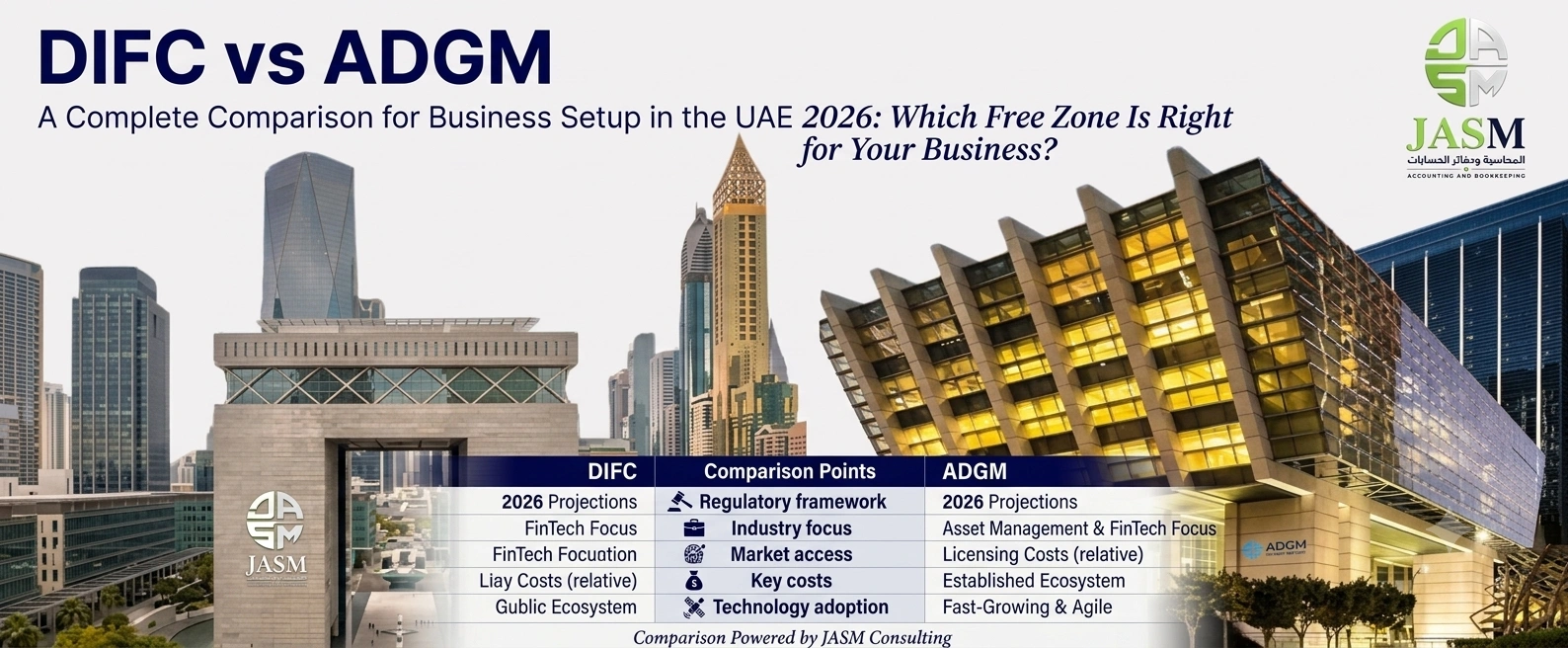
Both are common-law financial free zones. Both sit inside the UAE federation but operate under their own legal systems, regulators, and courts. Both can qualify for 0% corporate tax on qualifying income. And both are genuinely excellent choices — for the right kind of business.
The problem is that most DIFC vs ADGM comparison guides stop there. They cover costs, sector focus, and regulator names — and leave you to figure out the compliance implications yourself. What does choosing DIFC or ADGM mean for your corporate tax position? How do the two frameworks handle payroll and WPS? What are the audit requirements under each? What happens to your QFZP status if you grow into mainland UAE clients?
These are the questions that actually determine the total cost of operating in either jurisdiction — and they are almost never covered in setup guides written by company formation agents whose interest ends at the moment your licence is issued.
This guide covers the full picture — from setup costs and regulatory differences to the corporate tax, accounting, and compliance implications that will shape your first three years of operation in whichever jurisdiction you choose.
DIFC and ADGM What They Are and Why They Matter
DIFC — Dubai International Financial Centre Established in 2004 on a 110-acre site in the heart of Dubai, DIFC is the UAE’s largest and most established financial free zone. In 2026 it has 8,844 active companies — including 2,525 new registrations in 2025 alone. It is regulated by the Dubai Financial Services Authority (DFSA) and has its own independent court system — the DIFC Courts — operating under English common law. DIFC is home to the regional headquarters of most major international banks, law firms, and asset managers operating in the Middle East.
ADGM — Abu Dhabi Global Market Established in 2013 on Al Maryah Island in Abu Dhabi, ADGM is the newer and currently faster-growing of the two financial free zones. In 2026 it has 11,128 registered entities — a number that has grown rapidly as the Abu Dhabi government has positioned ADGM as its flagship business and innovation hub. ADGM is regulated by the Financial Services Regulatory Authority (FSRA) and applies English common law directly — the only jurisdiction in the UAE to do so. It has become the leading destination in the region for virtual assets, fintech, and fund management with Abu Dhabi government connectivity.
The most important thing to understand before choosing between them: DIFC and ADGM are not general-purpose free zones like DMCC or IFZA. They are specialist financial centres. Most activities require regulatory approval from DFSA (DIFC) or FSRA (ADGM) — not just a standard trade licence. If your business is not a financial services, professional services, technology, or holding structure — DIFC or ADGM may not be the right choice at all, and a broader free zone like DMCC or IFZA may serve your needs better at lower cost.
DIFC vs ADGM — Complete 2026 Comparison Table
| Factor | DIFC | ADGM |
|---|---|---|
| Location | Dubai — heart of city | Abu Dhabi — Al Maryah Island |
| Established | 2004 | 2013 |
| Active entities | 8,844 companies | 11,128 entities |
| Regulator | DFSA | FSRA |
| Court system | DIFC Courts | ADGM Courts |
| Legal system | English common law (DIFC-specific) | English common law (direct application) |
| Minimum setup cost | AED 16,515 (Innovation Licence) | AED 5,505 (Innovation Licence) |
| Visa quota | Up to 4 visas | Up to 10 visas |
| Visa processing time | 7 working days | 14 working days |
| Banking difficulty | Moderate | Moderate |
| Corporate tax rate | QFZP eligible — 0% on qualifying income | QFZP eligible — 0% on qualifying income |
| WPS requirement | DIFC Employment Law — separate WPS | ADGM Employment Regulations — separate framework |
| Audit requirement | Mandatory for regulated entities | Mandatory for regulated entities |
| Best for | Established finance, wealth, Islamic finance | Fintech, crypto, VC, family foundations |
Setup Costs — DIFC vs ADGM in Real AED Figures
This is the question most businesses ask first — and the answer is more nuanced than headline figures suggest.
DIFC setup costs 2026:
| Cost Component | AED Amount |
|---|---|
| Innovation Licence (non-regulated, small businesses) | AED 5,505 registration + AED 11,010 annual licence fee |
| Regulated entity licence (financial services) | AED 25,000 – AED 80,000+ depending on activity |
| Office space — co-working (Innovation Licence holders) | AED 11,010 per year (USD 250/month equivalent) |
| Office space — fitted unit | AED 80,000 – AED 300,000+ per year |
| Employment visa per person | AED 5,470 (7-day standard processing) |
| Minimum Year 1 total (non-regulated, 1 visa) | AED 33,000 – AED 45,000 |
ADGM setup costs 2026:
| Cost Component | AED Amount |
|---|---|
| Innovation Licence (non-regulated, startups) | AED 5,505 registration + AED 5,505 annual renewal |
| Regulated entity licence | AED 20,000 – AED 60,000+ depending on activity |
| Office space — shared workspace | AED 18,000 – AED 36,000 per year |
| Office space — dedicated office | AED 60,000 – AED 180,000+ per year |
| Employment visa per person | AED 4,000 – AED 5,500 (14-day standard processing) |
| Minimum Year 1 total (non-regulated, 1 visa) | AED 28,000 – AED 40,000 |
The headline cost conclusion: ADGM is cheaper at entry level — the Innovation Licence is AED 11,010 less in annual fees than the DIFC equivalent. For regulated activities, ADGM is also generally 20% to 30% lower in licensing fees. However, DIFC’s premium positioning means the comparison becomes more complex when factoring in staff attraction, client perception, and proximity to the Dubai financial ecosystem — all of which have real commercial value that does not appear in a cost table.
For businesses whose primary clients, partners, and talent pool are Dubai-based — the DIFC premium frequently justifies itself commercially within the first 12 to 18 months.
Regulation — DFSA vs FSRA — The Key Differences
Both regulators are internationally respected. Both operate under English common law. Both require authorisation for regulated financial activities. The differences are in emphasis and approach.
DFSA — Dubai Financial Services Authority: The DFSA has been regulating financial services since 2004. It has the deepest track record in the region — its authorisation decisions, enforcement actions, and supervisory framework are well understood by banks, legal firms, and global financial institutions. Its regulatory approach is broadly aligned with FCA (UK) standards — making it familiar to European and UK-based businesses expanding into the Middle East.
DFSA’s Fintech Innovation Testing Licence allows businesses to test innovative financial products in a controlled environment without full authorisation — a significant advantage for fintech firms that are not yet ready for full regulatory compliance.
FSRA — Financial Services Regulatory Authority: The FSRA is newer and in many areas more progressive — particularly on virtual assets, blockchain, and digital securities. ADGM was among the first jurisdictions globally to introduce a comprehensive framework for Virtual Asset Service Providers (VASPs) — and in 2026 has over 20 licensed virtual asset firms operating under FSRA supervision. For businesses in the crypto, Web3, and digital asset space, ADGM’s FSRA framework is widely regarded as the most mature and clearest in the UAE.
FSRA also has a flexible fund regulatory regime — specifically designed to accommodate VC funds, private equity, and hedge funds at multiple stages of development — which is why ADGM has become the preferred destination for fund managers with institutional investor bases connected to Abu Dhabi’s sovereign wealth ecosystem.
The practical choice: For banking, insurance, Islamic finance, and traditional asset management — DFSA at DIFC is the established, understood choice. For fintech, digital assets, VC, and innovation-driven financial services — FSRA at ADGM offers a more flexible and increasingly competitive framework.
DIFC vs ADGM Corporate Tax — The QFZP Implications
Both DIFC and ADGM companies can qualify as Qualifying Free Zone Persons — eligible for 0% corporate tax on qualifying income. Neither zone has a structural advantage over the other in terms of QFZP eligibility under the UAE Corporate Tax Law.
However, the compliance obligations that accompany QFZP status are different in each jurisdiction — and understanding these differences is the part of the DIFC vs ADGM decision that most guides omit entirely.
DIFC-specific corporate tax and compliance considerations:
- DIFC entities are subject to DIFC Employment Law — a separate employment regime from mainland UAE Labour Law — with its own end-of-service benefit calculations, notice period rules, and dispute resolution process through the DIFC Courts
- WPS for DIFC employees is processed through a DIFC-specific payroll mechanism — not the standard MOHRE WPS system
- DIFC regulated entities have mandatory annual audit requirements from their DFSA licence — aligned with QFZP audit requirements above AED 50 million revenue
- Transfer pricing documentation must be maintained for all related-party transactions — consistent with the QFZP framework
- DIFC entities file their corporate tax returns through the standard FTA EmaraTax portal — no separate DIFC CT filing mechanism
ADGM-specific corporate tax and compliance considerations:
- ADGM Employment Regulations apply — again separate from mainland UAE Labour Law, with different leave entitlements, termination procedures, and benefit calculations
- ADGM has its own WPS-equivalent system for salary protection — processed through ADGM’s framework rather than MOHRE
- ADGM regulated entities have mandatory audit and financial reporting requirements from FSRA licensing — independent of but aligned with the corporate tax audit threshold
- ADGM companies are registered in Abu Dhabi — meaning banking relationships are primarily with Abu Dhabi-headquartered or Abu Dhabi-branched financial institutions, which may affect practical banking arrangements if your operations are primarily Dubai-based
- ADGM entities also file corporate tax returns through EmaraTax — the FTA does not maintain separate filing channels for either free zone
The QFZP risk both share equally: Both DIFC and ADGM companies face the same QFZP de minimis threshold — non-qualifying income must not exceed 5% of total revenue or AED 5,000,000. For DIFC and ADGM entities that provide services to UAE mainland clients — which many professional services firms and technology companies do — monitoring this threshold is an ongoing compliance obligation that connects directly to the monthly accounting function.
Our corporate tax advisory team monitors qualifying vs non-qualifying income monthly for both DIFC and ADGM clients — providing advance warning when the de minimis threshold is being approached before it becomes a five-year 9% tax consequence.
DIFC vs ADGM for Specific Business Types
For financial services and banking: DIFC is the established choice. The concentration of banks, law firms, and financial institutions within DIFC creates a network ecosystem that is simply more developed than ADGM’s. If your business requires relationships with major international banks, DIFC’s financial community provides immediate proximity and credibility that ADGM — while growing rapidly — has not yet fully replicated.

For fintech, crypto, and Web3: ADGM and its FSRA lead this category in the UAE and increasingly globally. The FSRA’s Virtual Assets Regulatory Framework is the most comprehensive in the region. If your business requires a virtual asset service provider licence, a digital securities framework, or operates in the Web3 space — ADGM’s regulatory environment is more developed, more flexible, and more closely aligned with where this sector is heading.
For family offices and wealth management: DIFC has historically dominated for family offices — particularly those serving Asian and South Asian ultra-high-net-worth families where Dubai’s geographic and cultural positioning matters. ADGM is increasingly competitive for European and institutional wealth mandates where Abu Dhabi’s sovereign wealth connectivity is an advantage. ADGM Foundations — a specific legal vehicle under ADGM law for family wealth structuring — are also increasingly valued for estate planning and succession purposes.
For holding companies and SPV structures: ADGM has developed a reputation as the preferred jurisdiction for pure substance holding structures and SPVs — particularly where assets are in the UAE or broader MENA region and the beneficial owner needs a UAE-based holding layer. ADGM’s SPV regime is widely regarded as one of the most efficient in the region, and its Foundations provide flexible succession planning that mainland UAE structures cannot offer.
For professional services and consulting: Both work — but DIFC’s Dubai location is typically preferred for businesses whose clients and talent are primarily Dubai-based. ADGM’s lower cost base makes it more attractive for smaller professional services firms where the Abu Dhabi market is accessible or the business serves international clients remotely.
DIFC vs ADGM — Visa Quota and Staffing
The visa quota difference is one of the most practically significant factors for growing businesses and is consistently underemphasised in comparison guides.
DIFC allows up to 4 visas per entity under the standard licence — expandable with office upgrades. ADGM allows up to 10 visas per entity. For a business planning to hire more than 4 employees in its first two years, ADGM’s higher default quota offers immediate operational flexibility that DIFC’s structure requires additional cost to achieve.
Visa processing timelines differ too — DIFC processes employment visas in 7 working days while ADGM takes 14. For time-sensitive hiring — particularly for regulated roles requiring DFSA or FSRA individual authorisation — DIFC’s faster processing can be meaningfully valuable.
Both jurisdictions operate under their own employment regulations — not mainland UAE Labour Law — which affects payroll structure, end-of-service calculations, and compliance obligations. Our payroll services team handles both DIFC and ADGM employee payroll under the correct employment framework for each jurisdiction — ensuring end-of-service calculations, leave entitlements, and compensation structures comply with the specific rules that apply to each free zone.
Accounting and Compliance Obligations — What Operating in DIFC or ADGM Actually Requires
This is the section most setup guides omit — and the one that determines your ongoing cost of compliance once your licence is issued.
Both DIFC and ADGM require:
- Annual financial statements prepared in accordance with IFRS
- Mandatory audit for regulated entities — regardless of revenue threshold
- Corporate tax registration with the FTA within three months of incorporation
- Annual corporate tax return filed through EmaraTax
- Transfer pricing documentation for related-party transactions
- QFZP income monitoring to maintain 0% rate on qualifying income
- Anti-money laundering compliance — both jurisdictions require DNFBP registration for relevant activities
- UBO (Ultimate Beneficial Owner) register filing
Additional DIFC-specific requirements:
- DIFC Employment Law compliance — separate from mainland Labour Law
- DFSA compliance reporting for regulated entities — periodic and annual
- Data protection compliance under DIFC Data Protection Law 2020 (DIFC DPL)
Additional ADGM-specific requirements:
- ADGM Employment Regulations compliance
- FSRA compliance reporting for regulated entities
- ADGM’s own Data Protection Regulations — aligned with GDPR standards
The compliance burden in both jurisdictions is genuinely higher than in standard mainland or general free zone structures — which is why the cost of professional accounting and compliance support in DIFC and ADGM is typically higher than for comparable businesses in DMCC or IFZA.
For businesses considering either jurisdiction, integrating the ongoing accounting compliance cost into the setup decision is essential. Our accounting outsourcing service specifically covers DIFC and ADGM entities — managing IFRS financial statements, corporate tax returns, QFZP income monitoring, and financial reporting that satisfies both the DFSA/FSRA regulatory requirements and the FTA’s corporate tax framework simultaneously.
DIFC vs ADGM Courts — Why the Legal System Matters
Both DIFC and ADGM have independent court systems operating under English common law — a significant advantage for international businesses that want predictable, internationally recognisable legal outcomes rather than the UAE civil law system.
DIFC Courts have a 20-year track record. They are internationally recognised and their judgments are enforceable across the UAE through a 2009 Protocol between DIFC Courts and the Dubai Courts. They handle commercial disputes involving DIFC entities and have increasingly been used for non-DIFC disputes through their opt-in jurisdiction mechanism.
ADGM Courts apply English law directly — not a locally adapted version of it. This is the only jurisdiction in the UAE where English law is applied as-is, without adaptation. For businesses with significant UK legal heritage, UK-governed contracts, or institutional investors accustomed to English law structures, this distinction is commercially meaningful.
For businesses structuring holding arrangements, joint ventures, or fund vehicles that may involve dispute resolution, the choice of court system is part of the overall structure decision — not an afterthought.
5 FAQs — DIFC vs ADGM 2026
What is the main difference between DIFC and ADGM in the UAE? DIFC is located in Dubai and regulated by the DFSA — the established financial centre with 8,844 active companies, the deepest banking ecosystem in the region, and the strongest positioning for traditional financial services, Islamic finance, and wealth management. ADGM is in Abu Dhabi on Al Maryah Island, regulated by the FSRA — faster-growing, cheaper to enter, and the leading destination in the UAE for fintech, virtual assets, VC funds, and family foundations. Both operate under English common law with independent court systems, and both can qualify for 0% corporate tax on qualifying income as QFZPs.
Which is cheaper — DIFC or ADGM in 2026? ADGM is cheaper at entry level. The ADGM Innovation Licence starts from AED 5,505 including registration and renewal, compared to AED 16,515 for the DIFC Innovation Licence equivalent. For regulated entities, ADGM licensing fees are also generally 20% to 30% lower than DIFC. ADGM also has a higher default visa quota — up to 10 visas compared to DIFC’s 4 — reducing the cost of visa quota upgrades for growing teams. However, DIFC’s premium Dubai positioning, banking network access, and faster visa processing add commercial value that does not appear in fee comparisons but is real for Dubai-based businesses serving regional clients.
Do DIFC and ADGM companies pay corporate tax in UAE 2026? Both DIFC and ADGM companies are subject to UAE corporate tax and must register with the Federal Tax Authority through EmaraTax. Both can qualify as Qualifying Free Zone Persons — eligible for 0% corporate tax on qualifying income — subject to meeting all five QFZP conditions including adequate substance, qualifying income within de minimis limits, and transfer pricing compliance. Neither zone has a structural advantage over the other in QFZP eligibility. Non-qualifying income in both jurisdictions is taxed at 9% from the first dirham — with no AED 375,000 threshold relief.
Is ADGM better for crypto and virtual assets than DIFC? Yes — in 2026, ADGM’s FSRA has the more comprehensive and internationally recognised regulatory framework for virtual assets. ADGM has over 20 licensed virtual asset firms operating under FSRA supervision and was among the first jurisdictions globally to introduce a complete framework for VASPs, digital securities, and blockchain-based financial services. For businesses in crypto, Web3, or digital assets, ADGM’s FSRA framework provides greater regulatory clarity and a more established community of peer firms than the equivalent DFSA track in DIFC — though DFSA continues to develop its digital asset framework competitively.
Can a non-financial services business set up in DIFC or ADGM? Yes — both jurisdictions have Innovation Licence categories that allow non-regulated technology and professional services businesses to operate without financial services authorisation. DIFC’s Innovation Licence targets tech startups, innovation companies, and professional services. ADGM’s equivalent covers similar categories. However, both zones have a primary positioning as financial centres — their cost structures, compliance requirements, and community ecosystem reflect this. Non-financial businesses that do not specifically need common-law courts, financial zone credibility, or DFSA/FSRA regulatory access may find that a general-purpose free zone like DMCC or IFZA delivers better value at lower cost for their specific needs.
The Right Free Zone Is the One That Matches What You Are Building
DIFC and ADGM are both genuinely world-class financial centres. The question is not which is better — it is which is right for your specific business, your team’s location, your client base, your regulatory needs, and your compliance budget.
The businesses that choose poorly are not the ones that picked the wrong city. They are the ones that chose based on cost alone without modelling the compliance obligations, or that registered in a financial free zone for a business that does not need financial centre positioning — and then spent three years paying premium compliance costs that a general free zone would have resolved at a quarter of the price.
At JASM Accounting, we support businesses in both DIFC and ADGM with the complete compliance function — from corporate tax advisory and QFZP income monitoring, to payroll services under the correct employment framework, financial reporting that satisfies both DFSA/FSRA and FTA requirements, VAT compliance for any taxable supplies, and annual audit services for regulated entities — all from a single team that understands both jurisdictions.
The official comparison of DIFC and ADGM regulatory frameworks, licensing requirements, and entity types is available directly from the DIFC Authority and ADGM Registration Authority — the primary sources for entity registration, licence applications, and regulatory guidance in each jurisdiction.
📞 Book your free DIFC vs ADGM compliance consultation today: jasmaccounting.ae/contact
