
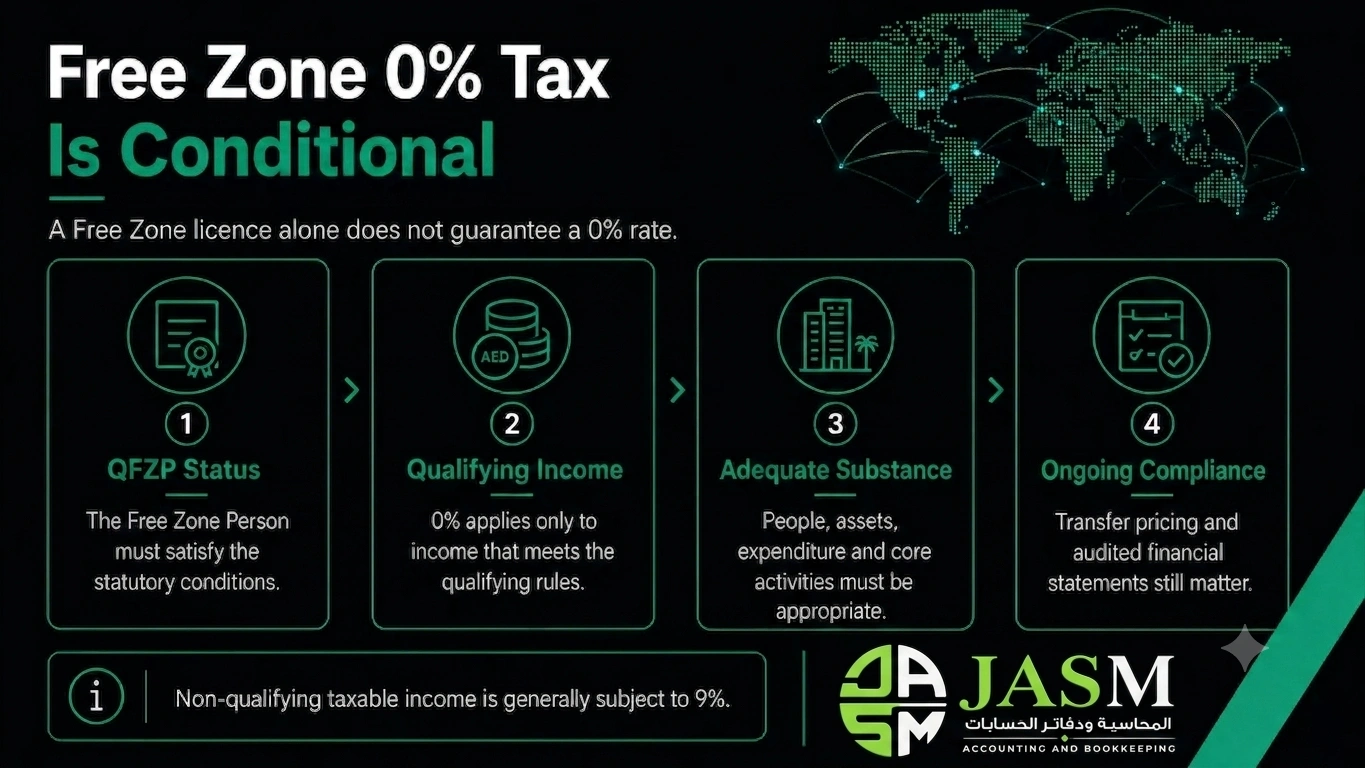
The most expensive myth in UAE business right now is this: if you have a free zone licence, you pay 0% corporate tax.
You do not. Not automatically. Not by default. And not just because you registered in a particular free zone.
The 0% corporate tax rate is available to free zone businesses — but only to those that qualify as a Qualifying Free Zone Person (QFZP) and only on their qualifying income. Every other dirham of profit earned by a free zone company is taxed at 9% — the same rate as a mainland company — with no AED 375,000 threshold relief once QFZP status is in play.
Here is what makes this particularly important in 2026: Ministerial Decision No. 229 of 2025 replaced the previous qualifying activities list from June 1, 2023 — retroactively. Businesses that have been filing returns based on the old list under MD 265 of 2023 need to verify their qualifying income position against the updated framework. And businesses that breach the QFZP conditions — even inadvertently — face 9% corporate tax not just for the breach year but for the breach year plus the following four years. Five years of 9% tax from a single compliance failure in one period.
This guide explains which free zones can qualify, what conditions your business must meet, how qualifying income is determined under the current framework, what the de minimis rule allows, and what happens when something goes wrong.
What Is a Qualifying Free Zone Person in UAE?
A Qualifying Free Zone Person (QFZP) is a free zone entity that meets a specific set of conditions under the UAE Corporate Tax Law — Federal Decree-Law No. 47 of 2022 — and its supporting regulations, most recently updated by Ministerial Decision No. 229 of 2025 and Cabinet Decision No. 100 of 2023.
A QFZP pays:
- 0% corporate tax on its qualifying income
- 9% corporate tax on its non-qualifying income — with no AED 375,000 threshold exemption
This is the detail that surprises almost every free zone business owner: when QFZP status applies, there is no threshold on non-qualifying income. A mainland LLC pays 0% on the first AED 375,000 of all taxable income. A QFZP pays 9% on every dirham of non-qualifying income from the first dirham. The 0% qualifying income rate comes at the cost of threshold relief on the non-qualifying portion.
The QFZP framework is a gate — not a menu. Every condition must be satisfied simultaneously. Passing four out of five conditions still results in full 9% corporate tax on all income — not a partial benefit.
Which UAE Free Zones Can Qualify for 0% Corporate Tax?
This is the most-searched question in the entire QFZP landscape — and the one most online guides answer incorrectly or not at all.
The answer is not a fixed list of approved free zones. The UAE Corporate Tax Law does not designate specific free zones as qualifying and others as non-qualifying. Instead, QFZP status is available to any free zone juridical person — a company legally registered in any UAE free zone — provided that company meets all QFZP conditions.
What this means in practice:
A DMCC company can be a QFZP. An IFZA company can be a QFZP. A JAFZA company, a RAKEZ company, a Sharjah Media City company, a DIFC company, an ADGM company — all can potentially qualify. The free zone itself does not determine QFZP status. The company’s specific activities, income mix, substance, and compliance do.

Free zone-specific considerations:
| Free Zone | Key QFZP Consideration |
|---|---|
| DMCC | Strong for trading and commodities — distribution of goods qualifies if conducted within DMCC or to other free zones or internationally |
| JAFZA | Strongest designated zone status for goods — manufacturing and trading income qualifies broadly |
| DIFC | Financial services — qualifying income framework applies specifically to regulated DIFC activities |
| ADGM | Financial and professional services — QFZP available but regulated activity conditions apply |
| IFZA | Broad activity scope — professional services and international trading qualify; mainland UAE service income does not |
| RAKEZ | Manufacturing and trading — qualifying income well-supported for international and inter-free-zone transactions |
| Sharjah Media City (SHAMS) | Media, creative, and professional services — qualifying if conducted internationally or with other free zones |
| DAFZA | Aviation and logistics — qualifying for international trading; domestic UAE delivery excluded |
| UAQ FTZ | Manufacturing and trading — designated zone advantages for goods |
In all cases, the QFZP conditions apply equally regardless of which free zone the entity is registered in. The free zone licence is only the starting point — what determines 0% or 9% is what the company does, who it does it with, and whether it has genuine substance where it operates.
The Five QFZP Conditions — All Must Be Met
Condition 1: You must be a Free Zone Person You must be a juridical person — a company, not an individual — registered and licensed in a UAE free zone. Individual freelancers and natural persons operating from free zones are not Free Zone Persons for corporate tax purposes and cannot be QFZPs.
Condition 2: You must have adequate economic substance in the UAE The three-pillar substance test applies — people, premises, and expenditure — all within the UAE and appropriate to the scale of your operations. A flexi-desk arrangement with one part-time administrator and minimal UAE expenditure does not satisfy this condition for a business with meaningful revenue.
This is the condition most frequently failed in 2026 — and the one that has the most severe consequences because failing it triggers the five-year 9% exposure.
Condition 3: You must derive only qualifying income — or satisfy the de minimis rule Your income must either be fully qualifying, or your non-qualifying income must stay within the de minimis limits. Full details of qualifying income and the de minimis rule are covered in the sections below.
Condition 4: You must not have elected to be taxed at 9% A free zone company can voluntarily opt into the standard 9% corporate tax regime — for example, if it has significant losses to carry forward or prefers the simplicity of the standard framework. Once this election is made, QFZP status is not available. The election is irrevocable for the period in which it is made.
Condition 5: You must comply with transfer pricing rules for related-party transactions Any transaction with a related party — a parent company, a subsidiary, a sister entity, a company owned by the same shareholder — must be priced on arm’s length terms. The relevant documentation must be maintained and, where required, submitted with the corporate tax return as a transfer pricing disclosure. Failure to comply with transfer pricing requirements is treated as a QFZP condition failure — meaning 9% applies to all income for that period.
Qualifying Income Under Ministerial Decision 229 of 2025
This is the most technically important update in 2026 — and the one most online guides are not yet reflecting accurately.
Ministerial Decision No. 229 of 2025 replaced the previous qualifying activities list under MD 265 of 2023 and applies retroactively from June 1, 2023 — meaning it affects returns that have already been filed. The updated qualifying activities list is now the definitive framework for determining whether a specific type of income is qualifying.
What counts as qualifying income under MD 229 of 2025:
| Income Category | Qualifying? | Conditions |
|---|---|---|
| Transactions with other free zone persons | ✅ Yes | Must not be an excluded activity |
| International trade — goods | ✅ Yes | Goods sold to customers outside UAE |
| International services | ✅ Yes | Services provided to non-UAE customers |
| Manufacturing within a designated zone | ✅ Yes | Physical manufacturing in the free zone |
| Holding of shares and securities | ✅ Yes | Passive income from qualifying investments |
| Fund management activities | ✅ Yes | If regulated financial service |
| Shipping income | ✅ Yes | Operation of qualifying ships |
| Logistics and distribution (goods) in designated zones | ✅ Yes | Must be within or between designated zones |
| IP income from qualifying intellectual property | ✅ Yes | R&D must have been conducted in UAE |
| Sales to UAE mainland businesses (B2B services) | ❌ No | Non-qualifying — counts toward de minimis |
| Sales to UAE mainland consumers (B2C) | ❌ No | Non-qualifying — counts toward de minimis |
| Banking and financial services to mainland UAE | ❌ No | Excluded activities |
| Insurance services to mainland UAE | ❌ No | Excluded activities |
Key change under MD 229 vs the old MD 265: The updated decision provides greater clarity on IP income and fund management qualifying conditions, and specifically confirms that distribution of goods qualifies only when conducted within or between free zones or to international customers — not to UAE mainland recipients. This has affected a number of DMCC and JAFZA trading companies that had been treating all product distribution as qualifying.
For businesses that filed earlier returns based on the MD 265 framework and whose income classification may differ under MD 229, a VAT compliance review and corporate tax position assessment is recommended before the next return is filed.
The De Minimis Rule — How Much Non-Qualifying Income Is Allowed?
The de minimis rule is the safety valve that prevents QFZP status from being lost due to minor or incidental non-qualifying income.
Under Cabinet Decision No. 100 of 2023, a QFZP can have non-qualifying income of up to the lower of:
- 5% of total revenue, or
- AED 5,000,000
If non-qualifying income stays within these limits, QFZP status is maintained — and the non-qualifying income is still taxed at 9%, but qualifying income retains the 0% rate.
Real AED examples:
| Total Revenue | Non-Qualifying Revenue | 5% Limit | AED 5M Limit | De Minimis Passed? |
|---|---|---|---|---|
| AED 2,000,000 | AED 80,000 | AED 100,000 | AED 5,000,000 | ✅ Yes |
| AED 2,000,000 | AED 120,000 | AED 100,000 | AED 5,000,000 | ❌ No — exceeds 5% |
| AED 8,000,000 | AED 380,000 | AED 400,000 | AED 5,000,000 | ✅ Yes |
| AED 80,000,000 | AED 3,000,000 | AED 4,000,000 | AED 5,000,000 | ✅ Yes |
| AED 120,000,000 | AED 6,000,000 | AED 6,000,000 | AED 5,000,000 | ❌ No — exceeds AED 5M |
The critical point most businesses miss: When non-qualifying income exceeds the de minimis limit — even by AED 1 — QFZP status is lost for the entire period. Not just the excess above the limit. The entire business loses QFZP status, and 9% applies to all income for that period.
For a business with AED 3,000,000 in qualifying income and AED 160,000 in non-qualifying income (8% of total AED 2,000,000 revenue scenario above), the QFZP breach results in 9% tax on the entire AED 3,000,000 + AED 160,000 = AED 3,160,000 income — a tax bill of approximately AED 247,275 on income that would otherwise have been taxed at either 0% (qualifying) or 9% on just the AED 160,000 (AED 14,400).
This is the most financially dangerous aspect of the QFZP framework — and the one that requires monthly monitoring rather than an annual year-end calculation. Our accounting outsourcing service tracks qualifying vs non-qualifying income monthly for free zone clients — providing advance warning when the 5% threshold is being approached before the year closes.
The QFZP Breach — Five Years at 9%
This is the consequence that makes QFZP status management genuinely urgent — and the one almost no competitor guide explains clearly.
When a business loses QFZP status due to any condition failure — substance test failure, de minimis breach, related-party transfer pricing non-compliance, or opting into the standard 9% regime — the consequences extend far beyond the breach period:
- Year 1 (breach year): 9% on all income — no 0% rate on any income
- Years 2, 3, 4, 5 (following four periods): Continued loss of QFZP status — 9% on all income
- Year 6: Re-qualification test — if all conditions are met, QFZP status can be restored
Real AED consequence — a single de minimis breach:
A DMCC trading company with AED 5,000,000 in annual qualifying income breaches de minimis in 2025 by generating AED 280,000 (5.6% of AED 5,280,000 total revenue) in UAE mainland sales.
- Tax if QFZP: 0% on AED 5,000,000 = AED 0 + 9% on AED 280,000 = AED 25,200
- Tax after QFZP breach — year 1: 9% on AED 4,905,000 (above AED 375K threshold) = AED 441,450
- Tax for years 2–5: approximately AED 441,450 per year × 4 years = AED 1,765,800
- Total five-year tax consequence of one breach: approximately AED 2,207,250
From a single year where mainland sales exceeded 5% of revenue — possibly from one large project, one unexpected contract, or one unplanned transaction.
This is why QFZP status cannot be managed reactively. It requires continuous monitoring, proactive tracking of qualifying vs non-qualifying revenue, and immediate action if the 5% threshold is being approached. Our corporate tax advisory team provides quarterly QFZP health checks as a standard part of free zone client management — because by the time a year-end calculation reveals a de minimis breach, it is already too late to correct it for that period.
QFZP vs Small Business Relief — Which Is Better?
For free zone businesses with revenue below AED 3 million, there is a genuine choice between QFZP status and Small Business Relief — and the two are mutually exclusive.
| Factor | QFZP | Small Business Relief |
|---|---|---|
| Revenue limit | None | AED 3 million maximum |
| Tax on qualifying income | 0% | N/A — all income treated as zero |
| Tax on non-qualifying income | 9% from dirham one | N/A — all income treated as zero |
| Substance requirement | Yes — three pillars | No |
| Transfer pricing compliance | Yes | Not required |
| Audited accounts | Yes — if revenue above AED 50M | No |
| Available after 2026 | Yes — ongoing | No — ends December 31, 2026 |
| Loss carry-forward | Yes | No — SBR forfeits losses |
For a small free zone business with AED 2,000,000 in revenue, all international clients, and a flexi-desk office arrangement:
- QFZP may fail on substance (flexi-desk) — risk of 9% on all income
- SBR gives zero tax with no substance requirement — safer for 2026
For a larger free zone business with genuine substance, significant qualifying income, and revenue above AED 3 million:
- QFZP is the only available route to 0% from 2027 onwards when SBR ends
- Building and maintaining QFZP conditions now is the most important corporate tax planning action available
QFZP and the Audit Requirement
Free zone businesses that qualify as QFZPs and have annual revenue of AED 50,000,000 or more must have their financial statements audited by a registered UAE auditor as a condition of QFZP status — not just as a corporate tax filing obligation.
For businesses below the AED 50 million threshold, audited accounts are not mandatory for QFZP status — but financial records must still be maintained in accordance with IFRS or IFRS for SMEs, and must be capable of supporting the qualifying vs non-qualifying income split if the FTA requests documentation.
Our financial reporting team prepares financial statements for free zone clients that are structured to clearly demonstrate the qualifying income position — ensuring that if the FTA ever asks for supporting evidence of QFZP status, the documentation is already in order.
5 FAQs Qualifying Free Zone UAE
Which UAE free zones qualify for 0% corporate tax in 2026? All UAE free zones can potentially qualify — QFZP status is not limited to specific approved free zones. A company registered in DMCC, JAFZA, IFZA, RAKEZ, DIFC, ADGM, Sharjah Media City, DAFZA, UAQ FTZ, or any other UAE free zone can be a QFZP, provided it meets all five conditions: free zone juridical person status, adequate economic substance, qualifying income within de minimis limits, no opt-in to 9% standard regime, and transfer pricing compliance. The free zone licence is only the starting point — QFZP status depends on the company’s specific activities, income mix, and substance.
What is qualifying income under UAE QFZP rules in 2026? Qualifying income under Ministerial Decision No. 229 of 2025 includes income from transactions with other free zone persons, international trade in goods and services with non-UAE customers, manufacturing within designated free zones, holding of qualifying shares and securities, regulated fund management activities, shipping income, and qualifying intellectual property income. Non-qualifying income includes sales of services or goods directly to UAE mainland businesses (B2B) and consumers (B2C), income from banking and insurance activities conducted with mainland UAE customers, and income from other excluded activities listed in MD 229. The updated list under MD 229 replaced MD 265 of 2023 retroactively from June 1, 2023.
What is the de minimis rule for UAE free zone QFZP status? The de minimis rule allows a QFZP to earn limited non-qualifying income without losing QFZP status — up to the lower of 5% of total revenue or AED 5,000,000. If non-qualifying income exceeds this threshold, QFZP status is lost for the entire tax period — meaning 9% applies to all income, including income that would otherwise have been qualifying. The breach does not just affect the excess above the limit. Even AED 1 over the de minimis threshold results in complete QFZP status loss for that period.
What happens when a UAE free zone company loses QFZP status? When QFZP conditions are breached, the consequences extend across five tax periods — the breach year and the four following years. During all five periods, 9% corporate tax applies to all taxable income with no 0% rate available. Re-qualification can only be tested from the sixth period onwards. For a free zone company with AED 5,000,000 in annual qualifying income, a single de minimis breach creates an estimated five-year corporate tax exposure of approximately AED 2,200,000 — compared to near-zero tax under intact QFZP status.
Can a QFZP also claim Small Business Relief in UAE? No — QFZP status and Small Business Relief are mutually exclusive under UAE Corporate Tax Law. A free zone company that has claimed QFZP status cannot elect SBR in the same tax period. Conversely, electing SBR forfeits the qualifying income treatment. For free zone companies with revenue below AED 3 million in 2026, the choice between the two must be modelled against their specific circumstances — particularly their substance position, their income mix, and whether they can maintain QFZP conditions after 2026 when SBR expires permanently.
QFZP Status Is the Most Valuable Tax Asset a UAE Free Zone Business Can Have and the Most Fragile
The 0% corporate tax rate for qualifying free zone income is not a right. It is a privilege earned by meeting five ongoing conditions simultaneously — conditions that require real substance, clean income classification, active transfer pricing compliance, and continuous monitoring of a revenue threshold that, if breached by even a small amount, costs five years of standard corporate tax.
The businesses that manage QFZP status well are not the ones that checked their qualifying income once at year-end. They are the ones tracking qualifying vs non-qualifying revenue monthly, reviewing their substance position before it becomes a problem, and integrating QFZP compliance into their accounting processes as a standard, ongoing function.
At JASM Accounting, our team helps UAE free zone businesses across DMCC, JAFZA, IFZA, RAKEZ, DIFC, ADGM, and all other UAE free zones maintain QFZP status correctly — through monthly qualifying income tracking as part of our accounting outsourcing service, annual substance assessments within our corporate tax advisory function, and financial reporting that clearly supports the qualifying income position in every corporate tax return filed through our corporate tax services.
The official QFZP framework — including the qualifying activities list under Ministerial Decision 229 of 2025 and the de minimis conditions under Cabinet Decision 100 of 2023 — is published on the UAE Ministry of Finance — the primary authority for all UAE corporate tax legislation and guidance.
📞 Book your free QFZP status assessment today: jasmaccounting.ae/contact
