
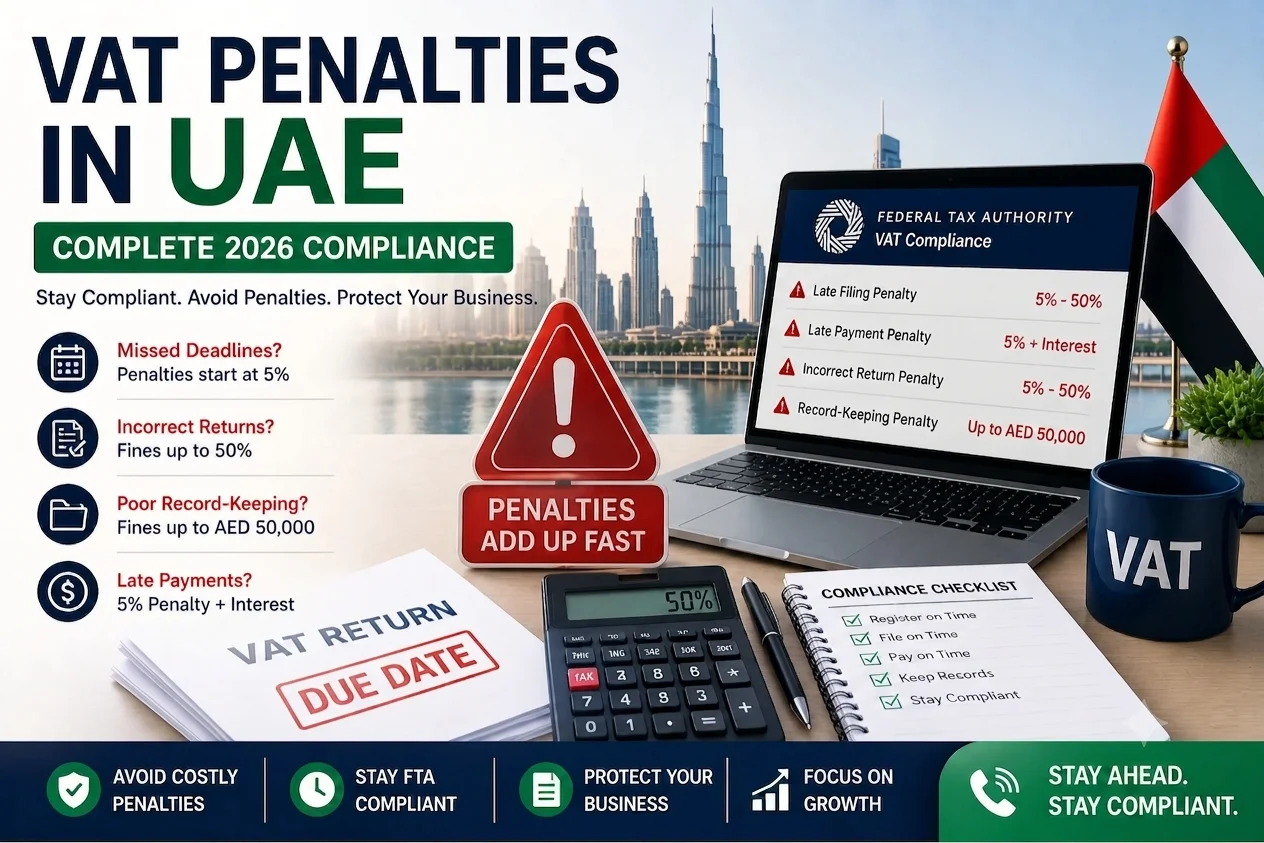
Getting a VAT penalty notice from the Federal Tax Authority is stressful especially when you are not entirely sure what went wrong, how much it will cost, or whether the figure on the notice is even correct.
Here is what most UAE business owners do not know: the VAT penalty framework changed significantly on April 14, 2026. Cabinet Decision No. 129 of 2025 restructured the entire penalty regime and for most businesses, the changes are actually more favourable than the old system, particularly for late payment. The old structure imposed 2% immediately on day one, then 4% per month, with a maximum cap of 300% of the unpaid tax. The new structure charges a flat 14% per annum, calculated monthly on the outstanding balance. For a business with a three-month late payment, that difference is substantial.
But here is the other thing most businesses do not know: the FTA conducted 93,000 inspection visits in 2024 — a 135% increase over the previous year. Its audit powers expanded further from January 2026 under the amended Tax Procedures Law. Enforcement is not slowing down. The penalty rates may have become more predictable, but the probability of facing them has never been higher.
This guide covers every VAT penalty UAE 2026 under the new Cabinet Decision 129 framework — the exact amounts, what triggers them, and the practical steps that prevent them. It also covers what to do if you have already received a notice, and why voluntary disclosure before an FTA audit is almost always the better financial decision.
What Changed on April 14, 2026 Cabinet Decision No. 129 of 2025
Before reviewing individual penalties, every UAE business needs to understand that the figures in most online guides published before April 2026 are no longer accurate. Cabinet Decision No. 129 of 2025, effective April 14, 2026, replaced the previous penalty framework under Cabinet Decision No. 40 of 2017 and its subsequent amendments.
The most significant changes under the new framework:
Late payment penalty restructured: The old penalty — 2% immediately, then 4% per month, capped at 300% — has been replaced with a flat 14% per annum, non-compounding rate, calculated monthly on the outstanding unpaid VAT balance. This is a significant reduction for businesses with long-outstanding balances, and makes the cost of late payment more predictable.
FTA-discovered errors now carry 15% fixed penalty: When the FTA identifies an error in your VAT return during an audit or desk review, a fixed penalty of 15% of the unpaid tax amount applies. This replaces the previous tiered structure.
Voluntary disclosure now carries 1% per month: When you identify an error and self-correct before the FTA initiates an audit, the penalty is 1% per month of the tax difference — calculated from the original filing deadline to the voluntary disclosure date. This dramatically rewards proactive self-correction over waiting for the FTA to find the error.
Failure to cooperate with FTA now penalised: Under the broadened scope of Cabinet Decision 129, any party — not just the business itself — that fails to facilitate an FTA auditor faces penalties. This extends to persons who obstruct access to premises, records, systems, or personnel during an inspection.
The Complete VAT Penalty Table UAE 2026
| Violation | Penalty Under Cabinet Decision 129 |
|---|---|
| Late VAT registration | AED 10,000 |
| Late VAT return filing (first offence) | AED 1,000 |
| Late VAT return filing (repeat within 24 months) | AED 2,000 |
| Error in VAT return (minor — corrected before deadline) | AED 0 |
| Error in VAT return (first offence — not corrected) | AED 500 |
| Late VAT payment | 14% per annum — non-compounding — calculated monthly |
| FTA-discovered error (audit finding) | 15% of unpaid tax amount |
| Voluntary disclosure (before FTA audit) | 1% per month of tax difference |
| Voluntary disclosure (after FTA audit initiated) | 15% fixed + 1% per month from original deadline |
| Failure to maintain required records (first offence) | AED 10,000 |
| Failure to maintain required records (repeat) | AED 20,000 |
| Non-compliant tax invoice | AED 5,000 per invoice |
| Failure to facilitate FTA auditor | AED 20,000 |
| Failure to display VAT-inclusive prices | AED 5,000 |
| Tax evasion | Criminal prosecution — imprisonment + fines |
Late VAT Registration The AED 10,000 Penalty Most Businesses Miss
The most straightforward VAT penalty in the UAE is also one of the most common: late registration. If your taxable supplies exceed AED 375,000 in any 12-month period and you do not register within 30 days, the FTA applies an automatic AED 10,000 administrative fine.
There is no warning notice. There is no grace period. The day you should have been registered and were not, the penalty clock started.
What makes this particularly relevant in 2026 is that the FTA now cross-references VAT registration data against Corporate Tax filings, Customs data, and banking information to identify businesses that may have crossed the registration threshold without registering. If the FTA identifies an unregistered business, the AED 10,000 penalty applies — and the FTA can also calculate and assess the output VAT that should have been collected during the unregistered period, plus late payment interest at 14% per annum.
If your business crossed the AED 375,000 threshold before completing registration — even if the delay was short and unintentional — proactively registering and making a voluntary disclosure is significantly cheaper than waiting for the FTA to identify the gap. Our VAT services team handles late registration situations regularly, including preparation of the voluntary disclosure alongside the registration application.
Late VAT Filing AED 1,000 and the Repeat Offence Trap
The UAE VAT return is due within 28 days of the end of each tax period — quarterly for most businesses, monthly for those with annual taxable supplies exceeding AED 150,000,000. Missing this deadline costs AED 1,000 for the first offence — and AED 2,000 for any repeat offence within 24 months.
These amounts sound manageable individually. The problem is repetition. A business that consistently files one week late because its accounts are always finalised after the deadline racks up AED 1,000 to AED 2,000 per quarter — AED 4,000 to AED 8,000 per year — from a process issue that could be resolved with a structured monthly close and a dedicated compliance calendar.
More significantly, a pattern of late filings places the business in the higher-risk tier of the FTA’s audit selection model. The FTA’s risk-based audit system specifically flags businesses with repeated late filings, frequent return amendments, and inconsistencies between VAT and Corporate Tax return data. Consistent late filing does not just cost money in direct penalties — it increases the probability of a full VAT audit.
Our accounting outsourcing team builds VAT filing deadlines into a managed compliance calendar for all clients — ensuring the return is prepared, reviewed, and submitted on time, every quarter, without depending on an internal team to remember and prioritise the deadline alongside everything else.
Late VAT Payment The New 14% Per Annum Rate Explained
This is the penalty change most UAE businesses do not yet know about — and it represents a genuine improvement over the previous framework.
Under the old system (pre-April 14, 2026):
- 2% penalty applied immediately on day one after the due date
- An additional 4% per month applied if unpaid after 7 days
- A further 1% daily penalty applied if still unpaid after one month
- Total could reach 300% of the unpaid tax
Under Cabinet Decision 129 (from April 14, 2026):
- 14% per annum, non-compounding, calculated monthly on the outstanding unpaid balance
Real AED comparison — AED 50,000 unpaid for 3 months:
| Framework | Penalty After 3 Months |
|---|---|
| Old system (pre-April 2026) | 2% day 1 = AED 1,000 + 4%/month × 3 = AED 6,000 = AED 7,000 |
| New system (from April 14, 2026) | 14% ÷ 12 × 3 months × AED 50,000 = AED 1,750 |
The new rate is substantially lower for most practical scenarios — and critically, it is predictable. You can calculate exactly what a late payment will cost before deciding whether to pay or defer, which the old compounding structure made very difficult.
However, do not interpret the lower rate as an invitation to delay. The 14% per annum rate, while more predictable, accrues from the day after the due date without any grace period — and the FTA’s expanded inspection capacity means unresolved late payments are increasingly likely to be identified.
The Most Expensive Penalty FTA-Discovered Errors at 15%
When the FTA identifies an error in your VAT return — whether through a desk audit, a field inspection, or an automated data check — a fixed penalty of 15% of the unpaid tax applies.
This is the penalty that makes the voluntary disclosure calculation so compelling. If you identify an error and self-correct before the FTA initiates an audit, you pay 1% per month from the original deadline to the disclosure date. If the FTA finds the same error first, you pay 15% — plus 1% per month from the original deadline to the date of assessment.
Real AED comparison — AED 100,000 underpayment identified 6 months after deadline:
| Route | Penalty |
|---|---|
| Voluntary disclosure before FTA audit | 1% × 6 months × AED 100,000 = AED 6,000 |
| FTA discovers error during audit | 15% × AED 100,000 = AED 15,000 + 1% × 6 months = AED 6,000 = AED 21,000 |
The difference — AED 15,000 — on a single error. For systematic errors repeated across multiple periods, this gap multiplies rapidly.
This comparison is the clearest financial argument for conducting regular VAT compliance reviews and a VAT health check before the FTA initiates contact. Finding the error yourself costs a fraction of the FTA finding it for you.
Non-Compliant Tax Invoices AED 5,000 Per Invoice
This is one of the most under-appreciated penalty categories in the UAE — because the amounts are per invoice, not per period. At AED 5,000 per non-compliant invoice, a business issuing 50 invoices per month with a systematic formatting error faces AED 250,000 in penalties from a single audit — for a problem that takes an afternoon to fix once identified.
Non-compliant invoices include:
- Missing mandatory fields — customer TRN, supplier TRN, sequential number, VAT amount in AED
- Incorrect VAT rate applied — standard-rated supply invoiced at 0%, or vice versa
- Foreign currency invoices without AED equivalent at Central Bank rate
- Sequential numbering gaps suggesting deleted invoices
Under Cabinet Decision 129, the scope of who can be penalised for invoice non-compliance has been broadened. It is no longer limited strictly to the issuing business — parties who facilitate non-compliant invoicing arrangements can also be exposed.
A VAT audit preparation review that samples your invoice register and identifies systematic formatting issues is one of the highest-return compliance investments a UAE business can make in 2026.
VAT Evasion Criminal Prosecution and the 15-Year Audit Window
The standard FTA audit limitation period is five years from the end of the relevant tax period. For cases involving tax evasion, this extends to 15 years — and the consequences move beyond administrative penalties into criminal prosecution.
Under Article 25 of the Tax Procedures Law, tax evasion includes deliberately providing false information to reduce tax liability, deliberately failing to submit returns to avoid payment, and deliberately concealing information that should have been disclosed. Tax evasion is a criminal offence in the UAE — punishable by imprisonment and fines — and where the FTA suspects it, the case can be referred directly to the Public Prosecution.
Businesses that discover deliberate errors in their historical filings should seek qualified advice before submitting voluntary disclosures — because the disclosure itself creates a documented record. Our corporate tax advisory team handles sensitive historical compliance situations with the discretion and professional judgment they require.
The FTA Penalty Waiver An Opportunity Most Businesses Missed
The Federal Tax Authority launched a specific initiative to waive administrative penalties for late submission of Corporate Tax registration applications within a specified deadline. This initiative was designed to support businesses during the initial corporate tax implementation period.
While the specific waiver window for corporate tax registration has passed, the FTA’s willingness to waive penalties in specific circumstances is a precedent worth understanding. Businesses that have incurred penalties for genuine first-time administrative errors — particularly where there was no tax loss to the FTA — can submit a penalty reconsideration request through EmaraTax and may receive a partial or full waiver at the FTA’s discretion.
The reconsideration process requires:
- Filing within 20 business days of receiving the penalty notification
- A written explanation of the circumstances
- Supporting documentation
- Submission through the EmaraTax portal
If reconsideration is rejected, an appeal can be made to the Tax Disputes Resolution Committee (TDRC) within another 20 business days.
How to Avoid VAT Penalties UAE 2026 The Practical Prevention Checklist
Based on our VAT record keeping and compliance work across UAE businesses, these are the five actions that eliminate the majority of VAT penalty exposure:
1. Register before you cross the threshold Monitor your rolling 12-month taxable supplies and register proactively — not reactively. The AED 375,000 threshold is not a cliff you fall off on day one. Build the registration process into your financial planning when you are approaching AED 300,000, not after you have already crossed AED 400,000.
2. File on time — every quarter Mark the 28-day filing deadline on the business calendar and build the return preparation into the month-end close process. A managed compliance calendar eliminates late filing penalties entirely.
3. Pay on time or manage the cost deliberately Under the new 14% per annum rate, late payment is predictable and manageable — but it still accrues from day one. If cash flow requires delay, calculate the cost explicitly rather than ignoring it.
4. Check your invoices systematically Verify that your invoice template includes all mandatory FTA fields and review a sample of issued invoices quarterly. One afternoon of invoice template review protects against AED 5,000 per invoice in audit findings.
5. Review and self-correct before the FTA does Conduct an annual VAT health check and submit voluntary disclosures for any errors identified. The 1% per month voluntary disclosure penalty versus the 15% FTA-discovered penalty is one of the clearest financial decisions in UAE tax compliance.
5 FAQs VAT Penalties UAE 2026
What changed in UAE VAT penalties from April 2026? Cabinet Decision No. 129 of 2025, effective April 14, 2026, restructured the entire UAE VAT penalty framework. The most significant change is the late payment penalty — replaced from the old compounding structure (2% day one, 4% monthly, capped at 300%) with a flat 14% per annum non-compounding rate. The FTA-discovered error penalty is now a fixed 15% of the unpaid tax. Voluntary disclosures before an FTA audit carry 1% per month on the tax difference. For most businesses, the new framework is more predictable and lower-cost than the previous one — but enforcement activity has increased significantly alongside it.
What is the penalty for late VAT registration in UAE 2026? The penalty for late VAT registration is AED 10,000 — applied automatically when a business that should have registered for VAT fails to do so within 30 days of crossing the AED 375,000 mandatory threshold. There is no warning notice and no grace period. In addition to the AED 10,000 fine, the FTA can assess output VAT that should have been collected during the unregistered period, plus late payment interest at 14% per annum from the date registration should have occurred.
How much is the VAT late payment penalty in UAE 2026? From April 14, 2026, the late payment penalty is 14% per annum, non-compounding, calculated monthly on the outstanding unpaid VAT balance. This replaces the previous structure of 2% immediately, then 4% per month, which could compound to 300% of the unpaid tax. For a AED 50,000 late payment over three months, the new rate results in AED 1,750 in penalties compared to AED 7,000 under the old structure. The rate applies from the day after the filing due date with no grace period.
Is voluntary disclosure cheaper than an FTA audit in UAE? Yes — significantly. Under Cabinet Decision 129, voluntary disclosures filed before the FTA initiates an audit carry a penalty of 1% per month of the tax difference from the original deadline to the disclosure date. The same error found by the FTA during an audit carries a fixed 15% penalty plus 1% per month. On an AED 100,000 underpayment identified six months after the deadline, voluntary disclosure costs AED 6,000 compared to AED 21,000 if the FTA finds it first. Proactive identification through VAT health checks and prompt voluntary disclosure is consistently the most cost-effective approach to historic VAT errors.
How do I appeal a VAT penalty in UAE 2026? You have two options. If you believe the penalty is incorrect or unjust, file a penalty reconsideration request through the EmaraTax portal within 20 business days of receiving the penalty notification. Submit a written explanation and supporting documentation. If the reconsideration is rejected, you can appeal to the Tax Disputes Resolution Committee (TDRC) within another 20 business days. If the TDRC decision is also unfavourable, the matter can proceed to the Federal Court. For penalties where you accept the violation occurred, paying within the specified timeframe avoids additional interest accrual.
Pay Less in Penalties By Acting Before the FTA Does
The UAE VAT penalty framework in 2026 is more predictable than it was before April 14. The new 14% annual rate for late payment, the clear 1% voluntary disclosure pathway, and the transparent 15% audit-discovery penalty all give businesses more certainty about the cost of non-compliance.
What has not become more predictable is whether the FTA will find your errors. With 93,000 inspection visits in 2024 — a number that is continuing to rise in 2026 — and an AI-driven audit selection system that cross-matches VAT returns against Corporate Tax filings, bank data, and Customs records, the assumption that non-compliance will go unnoticed is genuinely risky.
At JASM Accounting, our VAT specialists help UAE businesses across Dubai, Abu Dhabi, Sharjah, and all free zones stay fully compliant with the 2026 penalty framework — through accurate VAT return filing, proactive VAT compliance reviews, and where errors are identified, voluntary disclosure preparation and FTA correspondence management through our financial reporting support.
The complete Cabinet Decision No. 129 of 2025 penalty framework is published on the Federal Tax Authority UAE official website — the primary authority for all UAE VAT and tax penalty information.
Book your free VAT penalty review today: jasmaccounting.ae/contact

One comment