
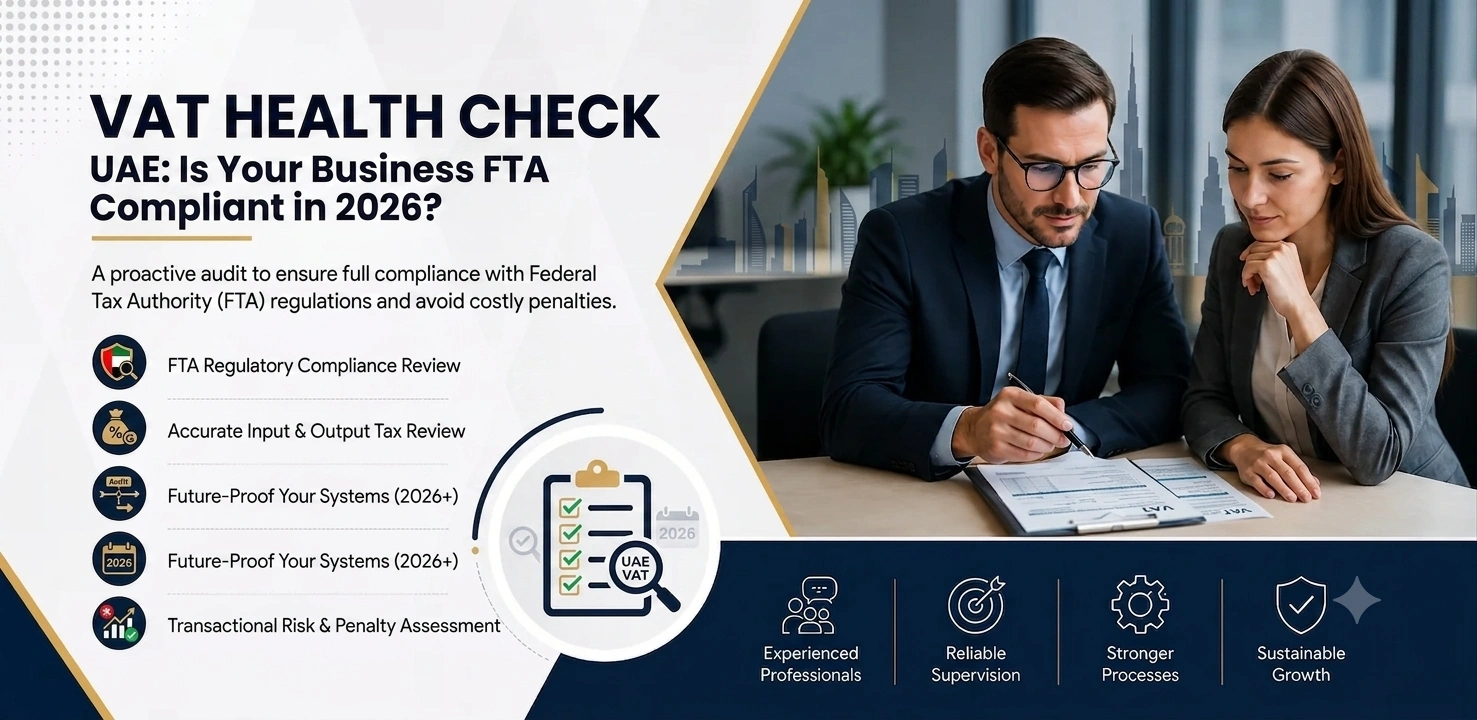
Most UAE businesses only discover their VAT errors when the FTA does and that is the most expensive time to find them.
A minor invoice formatting issue from 18 months ago. Input VAT claimed on entertainment expenses that was fully blocked. A reverse charge transaction reported in the wrong Form 201 box. Individually, each one seems small. Together, they represent a pattern of non-compliance that the FTA’s automated cross-checking systems are increasingly effective at identifying — and that carries penalties of AED 2,500 per incorrect invoice, 50% of any underpaid tax, and up to AED 50,000 for record-keeping failures.
The entire point of a VAT health check UAE is to find and fix these issues before the FTA does when the cost of correction is a voluntary disclosure fee rather than a formal audit penalty. In 2026, with the FTA now cross-referencing VAT returns against Corporate Tax filings in real time, this proactive approach is no longer just good practice. It is a genuine financial protection strategy.
This guide explains exactly what a VAT health check covers, what the 2026 FTA environment means for UAE businesses, and how to assess whether your VAT position is genuinely clean or quietly accumulating risk.
What Is a VAT Health Check in UAE?
A VAT health check — also known as a VAT compliance review, VAT pre-audit review, or VAT due diligence — is a structured, independent assessment of your business’s VAT processes, return accuracy, invoice compliance, and record-keeping against the requirements of the UAE VAT law and FTA regulations.
It is not the same as an FTA audit. An FTA audit is initiated by the tax authority — you have no choice about whether it happens and limited time to prepare once it starts. A VAT health check is initiated by you — on your own timeline, with full control over what is reviewed and how findings are addressed.
The practical difference in cost is significant. Errors identified during an FTA audit attract the full penalty schedule — AED 2,500 per incorrect invoice, 50% of unpaid tax, and potentially much more for serious or systematic issues. The same errors identified during an independent VAT health check can be corrected through a voluntary disclosure at a substantially reduced penalty rate. The FTA explicitly rewards proactive self-correction — which is the entire financial logic behind conducting a health check before an audit, not after.
Why a VAT Health Check Matters More in 2026 Than Ever Before
Three specific developments in 2026 have made proactive VAT compliance reviews significantly more important for UAE businesses:
Development 1: FTA Cross-Matching VAT and Corporate Tax Returns
From January 1, 2026, the FTA actively cross-references the revenue figures declared in your quarterly VAT returns against the income reported in your annual Corporate Tax return. Any material discrepancy between the two — different revenue figures, different transaction counts, inconsistent treatment of the same supplies — triggers an automatic compliance flag that can lead to a VAT audit, a Corporate Tax audit, or both simultaneously.
Businesses that have been treating VAT and Corporate Tax as two separate compliance exercises managed by different people without any reconciliation step are creating exactly the data discrepancies that the FTA’s systems are designed to detect. A VAT health check that includes a cross-filing reconciliation identifies these gaps before the FTA does.
Development 2: VAT Credits Expiring December 31, 2026
Any VAT credit balance accumulated between 2018 and 2021 that has not been claimed or offset will expire permanently on December 31, 2026. A health check that reviews your historic EmaraTax balance position may identify significant refundable credits you did not know you had — credits that disappear forever if not claimed before the deadline.
Development 3: E-Invoicing Transition Approaching
With mandatory e-invoicing beginning for large businesses in January 2027 and rolling out to all VAT-registered businesses through 2027, the accuracy of your current invoice data has never mattered more. Businesses with systemic invoice formatting errors entering the e-invoicing mandate with those errors embedded in their processes will face significantly higher exposure than those that correct them now.
VAT Health Check vs VAT Audit UAE Understanding the Difference
This is one of the most commonly searched questions around VAT compliance in the UAE — and the distinction is important:
| Factor | VAT Health Check | FTA VAT Audit |
|---|---|---|
| Who initiates it | Your business — proactive | FTA — mandatory |
| When it happens | Your timeline — planned | FTA’s timeline — often short notice |
| Scope | You define the scope | FTA defines the scope |
| Findings | Internal report — confidential | Formal FTA assessment |
| Cost of errors found | Voluntary disclosure — reduced penalties | Full penalty schedule applies |
| Duration | 1 to 4 weeks typically | 2 to 12 weeks depending on complexity |
| Output | Action plan and corrections | Formal assessment and payment notice |
| Audit risk after | Significantly reduced | Penalties plus potential re-audit |
The core message is this: a VAT health check is something you do for yourself, on your terms, at a time of your choosing. An FTA audit is something that happens to you. The businesses that conduct regular health checks are the ones that pass FTA audits quickly and cleanly — because there is nothing unexpected to find.
What Does a VAT Health Check Cover in UAE?
A comprehensive VAT compliance review UAE covers six core areas — each of which represents a category of risk that the FTA specifically targets during audit selection and review:
1. VAT Registration Status and TRN Verification
Confirming that your Tax Registration Number is active, your registered business activities accurately reflect what you actually do, and your VAT registration details on EmaraTax match your current trade licence. Changes in business activities, new income streams, or additional UAE entities that were not registered can all create compliance gaps.
2. VAT Return Accuracy and Filing History
Reviewing your submitted VAT returns for mathematical accuracy, correct box usage on Form 201, and consistency with your underlying accounting records. Common errors include using the wrong box for zero-rated vs exempt vs standard-rated supplies, misreporting reverse charge transactions, and calculating VAT on inclusive prices instead of exclusive prices.
3. Tax Invoice Compliance Check
Sampling invoices from both your sales (output) and purchases (input) to verify all mandatory fields are present and correctly formatted. Missing a customer TRN, using sequential numbering gaps, failing to show VAT in AED on foreign currency invoices — any of these create non-compliant invoices that cannot support input VAT recovery claims and attract AED 2,500 penalties per invoice during an audit.
This is the area where most UAE businesses have the highest volume of errors — not because they are intentionally non-compliant, but because invoice templates were set up incorrectly years ago and the same errors have been replicated across thousands of transactions since.
4. Input VAT Recoverability Review
Checking that every input VAT claim in your returns was genuinely recoverable — that the expense was used for taxable business purposes, that blocked categories were correctly excluded, and that partial exemption calculations were applied where the business makes a mix of taxable and exempt supplies.
The most commonly overclaimed blocked categories include:
- Client entertainment — 50% blocked in all circumstances
- Passenger motor vehicles — blocked unless exclusively for business with zero private use
- Personal expenses of owners or family members
- Expenses related to exempt supplies
Any input VAT claimed on these categories represents an overstated input position that the FTA can assess and recover during an audit — with penalties on top.
5. Output VAT Completeness Review
Confirming that output VAT has been declared on every taxable supply — including deemed supplies that many businesses overlook, such as employee gifts above AED 500, personal use of business assets, and goods retained at VAT deregistration. Also verifying that tax point rules have been correctly applied — that advance payments received in one quarter were declared in that quarter’s return, not the later delivery period.
6. Record Retention and Audit Readiness
Confirming that all required VAT records — invoices, contracts, bank statements, customs documents, and reconciliations — are complete, organised, and accessible for the full five-year retention period. For businesses approaching the e-invoicing mandate, this review also assesses whether current record management processes will support the structured digital archiving requirements of the e-invoicing system.
The 12-Point VAT Health Check Checklist UAE 2026
Use this to quickly assess your current VAT compliance position:
| # | Check | Status |
|---|---|---|
| 1 | TRN is active and business activities are correctly registered | ✅ / ❌ |
| 2 | All VAT returns filed on time with no outstanding submissions | ✅ / ❌ |
| 3 | VAT return figures reconcile to trial balance for each period | ✅ / ❌ |
| 4 | VAT return revenue figures consistent with Corporate Tax filing | ✅ / ❌ |
| 5 | All sales invoices include mandatory fields including customer TRN | ✅ / ❌ |
| 6 | Sequential invoice numbering with no gaps | ✅ / ❌ |
| 7 | Foreign currency invoices show VAT in AED at Central Bank rate | ✅ / ❌ |
| 8 | Blocked input VAT categories excluded from all recovery claims | ✅ / ❌ |
| 9 | Reverse charge transactions reported in correct Form 201 boxes | ✅ / ❌ |
| 10 | Advance payments declared as output VAT in correct tax period | ✅ / ❌ |
| 11 | Historic VAT credit balances from 2018–2021 reviewed before Dec 2026 | ✅ / ❌ |
| 12 | All VAT records retained and accessible for five-year minimum | ✅ / ❌ |
Four or more ❌ items on this checklist means your business has active VAT compliance gaps. The question is whether the FTA finds them or you do — and which one costs more.
The Most Common VAT Errors Found During UAE Health Checks
Based on our VAT compliance reviews across Dubai and the UAE, these are the errors that appear most consistently — and cost businesses the most when the FTA identifies them first:
Error 1: Incorrect input VAT recovery on blocked expenses Entertainment, passenger vehicles, and personal expenses are the most frequently overclaimed categories. Most businesses have been claiming these for years without realising they were blocked — which means the cumulative liability across multiple VAT periods can be substantial.
Error 2: Wrong Form 201 boxes for specific supply types Zero-rated exports in Box 1 (standard-rated) instead of Box 3. Imported services not declared in Boxes 7 and 8. These are filing errors even when the VAT amount is mathematically correct — and they generate automatic system flags during FTA processing.
Error 3: Missing output VAT on advance payments Receiving payment in one quarter and reporting the VAT in a later quarter when the invoice was issued. This is the most common tax point timing error and creates a systematic underdeclaration of output VAT across multiple periods.
Error 4: Non-compliant invoices used to support input VAT recovery Claiming input VAT based on an invoice that is missing the supplier TRN, the VAT amount in AED, or sequential numbering. These invoices do not legally support input VAT recovery — meaning the FTA can disallow the claim entirely.
Error 5: VAT and Corporate Tax revenue figures inconsistent The newest and most dangerous error category in 2026. Revenue declared in quarterly VAT returns that does not reconcile with the income reported in the Corporate Tax return triggers automatic cross-filing flags in the FTA’s data analytics system. This is the error type most likely to initiate an unsolicited FTA contact in 2026.
Our VAT audit UAE preparation service addresses all five of these areas systematically — before they become FTA findings.
How Voluntary Disclosure Connects to Your VAT Health Check
When a VAT health check identifies errors in previously submitted returns, the correct response is a voluntary disclosure through EmaraTax — not silence.
A voluntary disclosure is a formal correction mechanism that allows businesses to self-report errors in their VAT returns before the FTA identifies them. The financial logic is straightforward: voluntary disclosures attract significantly reduced penalties compared to errors found during a formal FTA audit.
For errors identified in a health check:
- Voluntary disclosure before FTA audit: Reduced penalty — typically 50% of the standard rate or a fixed administrative fee depending on the error type
- Same error found by FTA during audit: Full penalty schedule applies — 50% of underpaid tax plus AED 2,500 per affected invoice
For businesses that have not reviewed their VAT position for 12 months or more — particularly those with complex supply types, high transaction volumes, or significant historic credit balances — the potential saving from a health check followed by voluntary disclosure is typically many times the cost of the review itself.
Our VAT services team handles both the health check identification and the voluntary disclosure filing as a complete process — so you move from identifying an issue to correcting it without any gap in the process.
When Should UAE Businesses Conduct a VAT Health Check?
There is no legal requirement to conduct a health check — it is a proactive choice. But certain business events make it particularly important:
| Trigger | Why It Matters |
|---|---|
| Annually — as a standard compliance practice | Catches accumulating errors before they become multi-year liabilities |
| Before an anticipated FTA audit | Allows correction through voluntary disclosure before formal review begins |
| After a significant business change | New revenue streams, new activities, or entity restructuring all affect VAT treatment |
| When changing accounting software or ERP | System migrations frequently introduce data mapping errors that affect VAT reporting |
| Before applying for a VAT refund | Ensures your return position is clean before a refund claim draws FTA scrutiny |
| After major regulatory changes | The 2026 amendments — five-year credit limit, self-invoice removal, anti-evasion rules — all require position review |
| When preparing for e-invoicing transition | Invoice data quality determines how smoothly your ASP integration works |
The FTA has publicly stated that businesses should treat VAT health checks as a regular part of their governance framework — not a one-time exercise before a specific event. Given that FTA audit frequency is increasing in 2026, the businesses that conduct annual health checks are the ones least surprised when an audit notice arrives.
VAT Health Check for Small Businesses UAE Is It Worth It?
A common misconception among UAE SMEs is that VAT health checks are only for large corporations with complex VAT positions. The reality is the opposite.
Large corporations have dedicated tax teams running internal compliance reviews continuously. Small businesses are the ones most likely to be operating with invoice templates set up incorrectly three years ago, input VAT being claimed on blocked categories without anyone realising, and VAT return boxes used inconsistently because the person who set them up has since left.
For a small UAE business with 50 invoices per month and three years of VAT returns, the potential penalty exposure from uncorrected errors across that period can easily exceed AED 100,000. The cost of a professional VAT health check is a fraction of that — and the correction through voluntary disclosure costs less than the penalty the FTA would apply.
Our accounting outsourcing service for UAE SMEs includes a periodic VAT position review as standard so your compliance position is monitored continuously rather than assessed in a crisis when an FTA notice arrives.
5 FAQs VAT Health Check UAE
What is a VAT health check in UAE? A VAT health check is a proactive, independent review of your business’s VAT compliance — covering return accuracy, invoice formatting, input tax recovery, output tax completeness, and record retention against FTA requirements. Also known as a VAT compliance review, VAT pre-audit review, or VAT due diligence, it identifies errors in your existing VAT position before the FTA does — allowing correction through voluntary disclosure at reduced penalties rather than facing the full penalty schedule during a formal audit.
How often should a UAE business do a VAT health check? At minimum, annually — ideally before filing each year-end VAT return. Businesses with high transaction volumes, complex supply types, or significant import-export activity should consider a review every six months. A health check is also strongly recommended after any major business change such as new revenue streams, system migrations, or significant regulatory updates — all of which affect VAT treatment in ways that are easy to misapply without a structured review.
What is the difference between a VAT health check and a VAT audit in UAE? A VAT health check is initiated by your business on your own timeline — you control the scope and any errors found can be corrected proactively through voluntary disclosure. An FTA VAT audit is initiated by the tax authority on short notice — you have no control over the scope and errors found are subject to the full penalty schedule. The financial difference between the two outcomes — for the same underlying error — can be tens of thousands of dirhams. The health check is the tool that makes the difference.
Can a VAT health check help avoid FTA penalties in UAE? Yes — directly and significantly. Errors identified during a voluntary, independent health check can be corrected through a voluntary disclosure to the FTA before any audit begins. Voluntary disclosures attract substantially reduced penalties compared to audit findings. For systematic errors repeated across multiple VAT periods — incorrect box usage, blocked input VAT claims, missing invoice fields — the penalty saving from self-correcting before an FTA audit versus being found during one can be substantial. The cost of a health check is almost always lower than the penalties it prevents.
What are the most common errors found during UAE VAT health checks? The five most commonly identified errors in UAE VAT health checks are: incorrect input VAT recovery on blocked expense categories such as entertainment and passenger vehicles; wrong Form 201 boxes for specific supply types particularly zero-rated exports and reverse charge imported services; missing output VAT on advance payments due to tax point timing errors; non-compliant invoices used to support input VAT claims where mandatory fields are absent; and inconsistencies between VAT return revenue figures and Corporate Tax filing income — a new high-risk category in 2026 due to the FTA’s automated cross-matching of both filings.
Find Your VAT Errors Before the FTA Does
A VAT health check is not a sign that something has gone wrong. It is a sign that your business takes its compliance obligations seriously enough to verify them independently — before the FTA’s systems do it for you, under their timeline and their penalty schedule.
In 2026, with the FTA cross-matching VAT and Corporate Tax data, with historic credit balances expiring, and with e-invoicing approaching, the businesses that are genuinely audit-ready are the ones that conduct structured compliance reviews regularly — not the ones that assume everything is fine because no audit notice has arrived yet.
At JASM Accounting, our VAT specialists conduct comprehensive VAT health check UAE reviews for businesses across Dubai, Abu Dhabi, Sharjah, and all free zones covering all six compliance areas, the complete 12-point checklist, and where errors are found, managing the voluntary disclosure process to correct them at minimum cost through our VAT record keeping and financial reporting support.
The Federal Tax Authority confirms that businesses can submit voluntary disclosures to self-correct VAT errors through the EmaraTax Portal and that proactive disclosure attracts significantly lower penalties than errors identified during a formal FTA audit.
Book your free VAT health check consultation today: jasmaccounting.ae/contact
